What are volleyball blocking drills? They train timing, footwork, and net awareness. Effective blockers read the hitter's approach, set their hands early, and jump straight up with hands over the net. The drills below run from individual technique through team blocking systems.

Volleyball Drills for Blocking

Blocking is the first line of defense at the net. A disciplined block forces hitters to adjust, creates deflection opportunities, and sets the tone for your entire defensive system.

These volleyball drills for blocking are from the SoloCoach library, organized from slide-step footwork through read-blocking and competitive net play.

From the makers of SoloStats

All of these drills are in SoloCoach

Filter by skill area, set time targets, and run your blocking block drill by drill with a countdown timer. Build a full practice plan in minutes.

Build your first practice plan, free
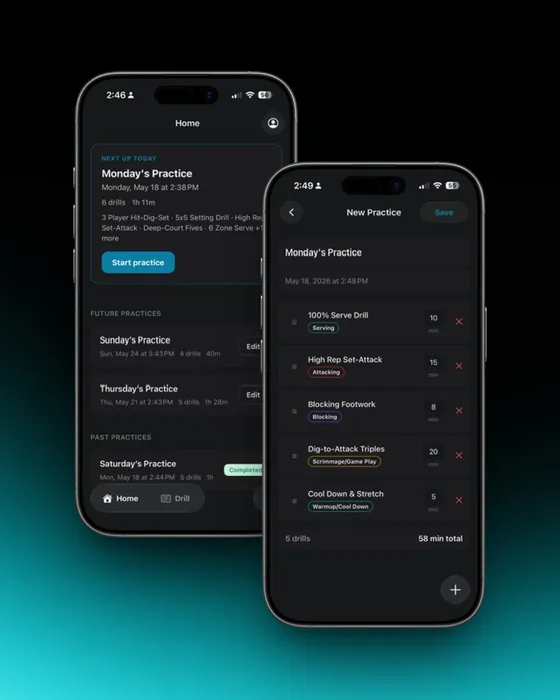
SoloCoach app, practice home screen and plan builder

Beginner Blocking Drills

Foundation blocking drills. Use these with youth teams or as the first block of practice.

Basic Slide Drill

2+ playersNone10 min

Blockers practice the slide step pattern along the net, the fundamental footwork used to close a block or shift from one blocking position to another. Builds the lateral quickness and hip alignment that underpins all net defense.

  1. Line up blockers along the net in an athletic ready stance, hands raised to blocking height.
  2. On coach's signal, player slide-steps laterally along the net for 3–5 steps without crossing feet.
  3. At the end of the slide, player jumps and presents hands above the net as if blocking.
  4. Return with a slide in the opposite direction and repeat.
  5. Progress to cross-over steps for longer distances once the slide is clean.

Coaching Cues

  • Keep hips square to the net throughout, turning sideways makes your jump slow and your block angle wrong.
  • Stay on the balls of your feet the entire time; flat feet kill your lateral reaction speed.
  • Arms stay raised and ready in blocking position during all movement, lowering them mid-slide costs you the block.

Intermediate Blocking Drills

Reading, placement, and decision-making drills that add game pressure to the blocking foundation.

Blocking Overpasses

3+ playersBalls10 min

Players practice attacking overpasses, balls that cross the net and are attackable from the receiving side. Builds aggressive net instincts and the decision-making to swing or set on an overpass.

  1. Coach or feeder stands on one side and intentionally tosses or tips balls that drift over the net.
  2. Player on the receiving side must recognize the overpass immediately and decide: attack it or set it.
  3. If attackable (ball is above the net and hittable), the player swings at it aggressively.
  4. If not cleanly attackable, the player sets or passes it up to a teammate.
  5. Run 15 reps, varying the height and angle of the overpass.

Coaching Cues

  • Call "over!" the moment you see it cross, teammates need to clear your hitting lane immediately.
  • Attack it, do not push it: a firm swing beats a hesitant push every time on an overpass.
  • If the ball is too low or too far inside, do not swing, a controlled pass is better than an error.

Pin Blocker Proper Positioning Drill

3+ playersBalls10 min

Outside and right-side blockers drill correct net positioning relative to the hitter, closing the line, taking angle, or splitting the difference, based on scouted attack tendencies.

  1. Coach designates a hitter tendency: "line hitter," "angle hitter," or "50/50."
  2. Pin blocker sets their starting foot position and net depth based on the called tendency.
  3. Setter delivers a set; blocker adjusts final position and jumps.
  4. Coach evaluates: did the blocker take the correct seam? Was their inside hand channeling the ball to the defense?
  5. Run 5 reps per tendency, then switch the called tendency.

Coaching Cues

  • Line hitter: set your outside foot at the antenna and close the line, force everything cross-court.
  • Angle hitter: move one foot inside the antenna to take away the angle, conceding the line to the defense.
  • Your inside hand is the most important hand on the block, it directs the attack into your backcourt.

Advanced Blocking Drills

Competitive and system-level blocking work for club and high school teams.

Blockers Reading the Hitter

4+ playersBalls15 min

Blockers practice reading a hitter's shoulder angle, arm swing, and approach direction to predict attack location before jumping. Develops anticipatory blocking rather than reactive blocking.

  1. A hitter approaches and attacks from position 4. Blocker starts at the outside position.
  2. Round 1: blocker watches only, call out where they think the attack will go before the hitter contacts.
  3. Round 2: blocker reads and moves, but does not jump, focus is on positioning, not the block.
  4. Round 3: full blocking with a jump, use reads from Round 1 to time and position the block.
  5. After each rep, debrief: what cue told you the direction? Was the read correct?

Coaching Cues

  • Watch the hitter's hitting shoulder angle at the peak, it points toward the attack direction.
  • The approach angle tells you line vs. angle before the hitter even jumps.
  • Do not watch the ball during the approach, watch the hitter's body. The ball follows the body.

Middle Versus Middle

4+ playersBalls15 min

The middle blocker on one side competes directly against the middle hitter on the other side, one blocks, one attacks, then they switch. Competitive 1v1 format that sharpens both roles simultaneously.

  1. Middle hitter at position 3, middle blocker across the net at position 3.
  2. Setter delivers quick balls to the middle hitter.
  3. Middle blocker reads the approach and attempts to block.
  4. Hitter scores 1 for a kill; blocker scores 1 for a stuff block or deflection that lands on the hitter's side.
  5. Play to 7 points, then switch roles. Run 3 rounds each.

Coaching Cues

  • Blockers: your jump timing must match the hitter's contact point, early or late and the ball slides by.
  • Penetrate the net plane with your hands on the block, hands that stop at the tape give the hitter a seam.
  • Hitters: use the blocker's position against them. If they're inside, go outside. If they're late, hit high.

Rapid Middle Blocker Movement

3+ playersBalls10 min

Middle blocker moves continuously, blocking at position 3, then sliding to block at position 4, then back, as fast as possible. Builds the lateral speed and conditioning that allows middles to cover the full net.

  1. Middle blocker starts at position 3. Coach signals left or right by pointing or calling a number.
  2. Blocker slide-steps or cross-steps to the called position and performs a block jump.
  3. Immediately returns to position 3 and awaits the next signal.
  4. Coach varies timing, some signals come immediately, others after a 2-second delay.
  5. Run for 60 seconds continuously, then rest 30 seconds. Complete 4 sets.

Coaching Cues

  • Push off your outside foot on the first step, a flat push-off loses you 2 feet of lateral distance.
  • Do not fully land between blocks, stay light and be ready to change direction before you're fully down.
  • Arms stay above net height during transitions; dropping them and re-raising wastes time.

Stuff It and Win

5+ playersBalls15 min

Competitive drill where blockers earn points only for stuff blocks, clean blocks that land directly on the attacker's side. Raises the standard beyond just touching the ball and builds aggressive, penetrating block technique.

  1. Set up a full attacking system: setter, outside hitter, and middle hitter versus two blockers.
  2. Attackers run their offensive system. Blockers compete to stuff-block (ball lands on attacker's floor).
  3. Stuff block = 3 points for the blocking team. Deflection (ball stays in play) = 1 point. Attack kill = 2 for offense.
  4. Play to 15 points. Rotate attacker and blocker groups every round.
  5. Blockers must call their assignment (who takes the middle, who takes outside) before the set.

Coaching Cues

  • Penetrate the net plane with both hands, hands that stay on your side of the net cannot stuff anything.
  • Angle your wrists down and forward at the peak of the jump to direct the block back at the attacker.
  • Communicate your assignment before every play, two blockers going for the same ball is worse than one.

How to Progress Your Blocking Training

  1. Step 1

    Start with footwork. Basic Slide Drill teaches the pattern blockers use to close the block or move from middle to pin, before anyone jumps. Until the slide is clean, adding a live hitter creates missed assignments, not better blocking.

  2. Step 2

    Next, add positioning and overpass reads. Pin Blocker Proper Positioning and Blocking Overpasses train where to set up and when a free ball at the net is actually a block opportunity.

  3. Step 3

    Finish with reading. Blockers Reading the Hitter, Middle Versus Middle, and Rapid Middle Blocker Movement connect footwork to the hitter's approach. Stuff It and Win makes the block a scoring skill, not just a defensive one.

  4. Step 4

    Blocking and defense belong in the same practice. A well-formed block channels hitters into the zones your defenders are covering. Train both together.

Volleyball Blocking Drills, Frequently Asked Questions

What are the best volleyball blocking drills for beginners?
Start with Basic Slide Drill. Beginners need the footwork pattern, slide, plant, hands high, before they jump to block a live attack. Add a tossed ball at the net only after the slide is consistent.
How do you teach blocking footwork?
Teach the slide step along the net without a jump first. Cue “hips square, hands high, last step plants.” Basic Slide Drill isolates that pattern. Progress to Rapid Middle Blocker Movement once players can close without crossing their feet.
When should youth teams start blocking drills?
Once players can jump and land safely and the net is at an age-appropriate height. Keep early blocking work on footwork and hand position. Live blocking against full-speed hitters comes later.
How long should a blocking block last in practice?
Fifteen to twenty minutes is enough. Start with 5 minutes of footwork, add a positioning or overpass drill, and finish with a competitive read-block game. Longer blocks drop jump quality.
What is the difference between a stuff block and a deflection?
A stuff block is a kill off the blocker’s hands back onto the attacker’s court. A deflection is a controlled redirect that your defense can dig. Both are useful, Stuff It and Win trains the first; reading drills train the second.
    Volleyball Drills for Blocking, Footwork, Timing & Net Play | SoloCoach