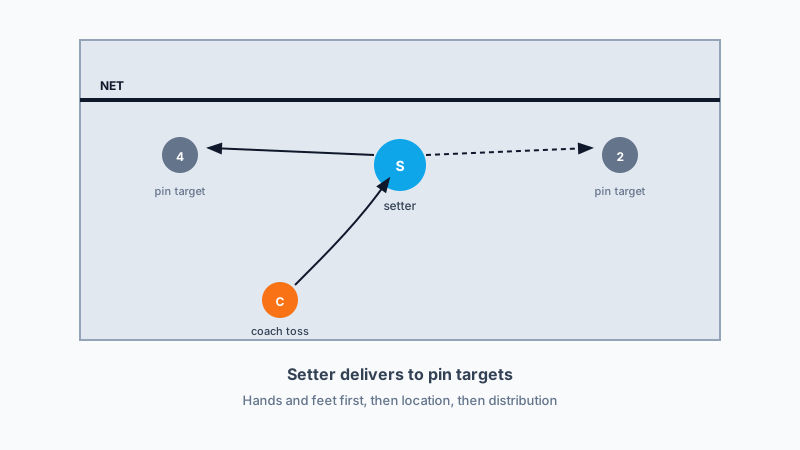
What are volleyball setting drills? They develop hand position, footwork, and decision-making at the setter position. Clean sets start with a stable base and soft hands, built through repetition before adding tempo and location. The drills below run from beginner hand-setting through full offensive system work.

Volleyball Drills for Setting

The setter runs your offense. Every pass that arrives on target gives the setter options, quick sets, slides, back sets, and dumps. When passing breaks down, the setter becomes a rescuer instead of a playmaker.

These volleyball setting drills are from the SoloCoach library. They cover hand-setting technique, footwork to the ball, and distribution under pressure.

From the makers of SoloStats

All of these drills are in SoloCoach

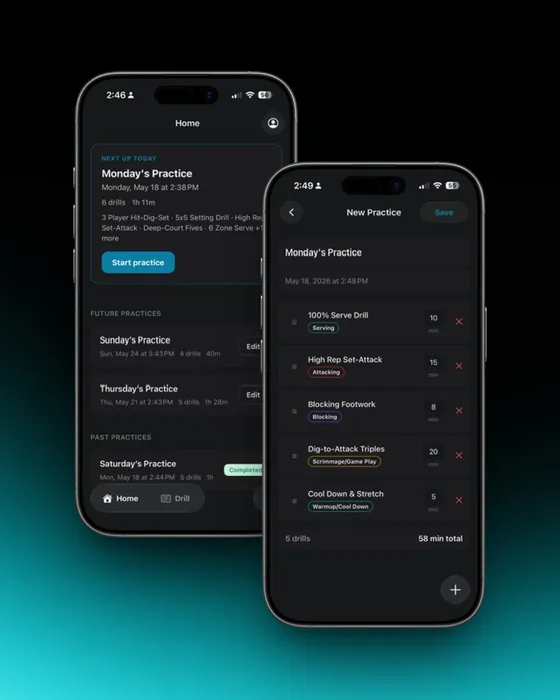
Filter setting drills by skill area, set time targets, and run your setter training block drill by drill with a countdown timer.

Build your first practice plan, free
SoloCoach app, practice home screen and plan builder

Beginner Setting Drills

Foundation setting drills. Use these with youth teams or as the first block of practice.

Set To Self Drill

1+ playersBalls10 min

Setter repeatedly sets the ball to themselves, moving, repositioning, then setting again. Isolates hand technique and footwork in a self-directed format that requires no partner.

  1. Setter starts with a ball in their hands, tossed lightly above their forehead.
  2. Set the ball 8–10 feet high, move 3 steps laterally, then set again before the ball lands.
  3. Continue moving and setting without the ball touching the floor.
  4. After 10 consecutive sets, add a directional target: set toward the wall or a cone each time.
  5. Count max consecutive sets, track personal best and compete session to session.

Coaching Cues

  • Both hands must contact simultaneously, one-handed pushes are a habit that kills consistency.
  • Contact the ball above your forehead with fingers spread wide; thumbs pointing toward your face.
  • Move your feet to get under the ball, reaching overhead without footwork builds bad mechanics.

Wall Setting Drill

1+ playersBalls10 min

Setter repeatedly sets into a wall target at net height, receiving the ball back off the rebound and setting again. Builds hand strength, touch, and repetition volume without a partner.

  1. Mark a target on a flat wall at approximately 8–9 feet high (net height) and 2 feet wide.
  2. Stand 6–8 feet from the wall and set the ball into the target.
  3. As it rebounds back, set it again immediately, do not let it drop.
  4. Count consecutive successful sets into the target zone.
  5. Increase difficulty: step back to 10 feet, or move laterally between each set.

Coaching Cues

  • Soft hands produce a ball that comes straight back at you; stiff hands produce unpredictable rebounds.
  • The wall is honest, a poor set bounces back poorly. Use the feedback instead of ignoring it.
  • Do not use a follow-through that pushes the ball downward, the ball should arc up into the target.

Intermediate Setting Drills

Reading, placement, and decision-making drills that add game pressure to the setting foundation.

4 or D Set

3+ playersBalls10 min

Setter practices delivering the 4-set (high outside) and D-set (back outside) alternately to hitters at both pins. Develops consistent delivery to both outside positions and trains hitters to read the set type.

  1. Setter stands at position 2. A passer or coach delivers balls from left back.
  2. Setter alternates: one 4-set (high ball to position 4, left outside) and one D-set (high ball to position 1, right outside).
  3. Hitters at each pin approach and attack, or catch if working on set quality only.
  4. Setter calls the set before delivering so hitters can time their approach.
  5. Run 10 sets to each side, then rotate a new setter in.

Coaching Cues

  • Square your hips to position 4 on every set, do not telegraph the D-set with your shoulders.
  • The D-set requires a back-angle extension; drive your right hand up and back through the ball.
  • Consistent height matters more than spin, hitters need to time their approach to a predictable arc.

5x5 Setting Drill

3+ playersBalls, Cones10 min

Setter delivers 5 sets to each of 5 different zones on the court in sequence. A structured accuracy drill that exposes inconsistency in set placement across different offensive options.

  1. Mark 5 target zones with cones: outside left (4), right side (2), middle (3), back row left (pipe), back row right.
  2. Coach or passer feeds balls to the setter at position 2.
  3. Setter delivers 5 consecutive sets to Zone 1, then 5 to Zone 2, and so on.
  4. A hitter or coach rates each set: 3 (on target), 2 (hittable), 1 (off).
  5. Track scores per zone, the zone with the lowest score gets extra focus next session.

Coaching Cues

  • Every zone requires a different body position and hand angle, do not use the same motion for all 5.
  • Footwork to the ball is 50% of the set, a setter who arrives late is always compromised.
  • Call each set type aloud as you deliver it: builds communication habits with hitters.

Arc Toss Setting

2+ playersBalls10 min

A partner tosses balls in a high arc to the setter, simulating a deep, looping pass. Forces the setter to handle off-tempo balls and maintain form when the ball arrives above and behind them.

  1. Partner stands at the net or mid-court and tosses balls in a high arc to various spots near the setter.
  2. Setter must move to the ball, get in position underneath it, and deliver a quality set.
  3. Vary the toss location: directly overhead, slightly back, slightly left, and slightly right.
  4. Setter should call "got it" as they move so the tosser knows not to intervene.
  5. Run 15–20 reps per setter, focusing on footwork to the ball and consistent hand position.

Coaching Cues

  • Get your feet under the ball before it arrives, setting with your arms only, without your legs, produces flat, uncontrolled sets.
  • High-arc balls drop fast; do not wait, start moving as soon as the toss leaves your partner's hands.
  • Contact the ball above your forehead at its peak, not as it falls past your face.

Rapid Continuous Sets

2+ playersBalls10 min

Setter delivers consecutive sets without pause as balls are fed rapidly. High-volume repetition drill that builds muscle memory and hand strength through sustained output.

  1. Coach or feeder stands 10 feet from the setter with a ball cart.
  2. Feeder tosses balls continuously every 3–4 seconds to a consistent spot.
  3. Setter delivers each ball to a designated target (cone, player, or net antenna).
  4. Run sets of 20 consecutive balls, resting 30 seconds between sets.
  5. Alternate target: 10 sets to position 4, then 10 sets to position 2 per set.

Coaching Cues

  • Stay light on your feet between balls, flat-footed setters slow down after the 10th rep.
  • Hand shape must reset identically after every set, lazy hands develop bad habits under fatigue.
  • Quality over speed: if the feeder is going too fast for you to set cleanly, ask them to slow down.

Set Distribution Drill

4+ playersBalls10 min

Setter practices distributing sets across all available hitters in a structured sequence, then on coach's call. Develops decision-making and the ability to go to any option under pressure.

  1. Position hitters at outside (4), right side (2), and middle (3). Setter at position 2.
  2. Round 1: setter runs through a predetermined sequence, 4, 2, 3, 4, 2, 3, without signals.
  3. Round 2: coach calls out a hitter's number just as the ball is fed, setter must deliver to the called option.
  4. Round 3: setter calls their own distribution, mixing all three options.
  5. Run 15 sets per round, rating each on hitter feedback: "I could attack that" or "I couldn't."

Coaching Cues

  • Square your hips to the same spot (outside) on every set, do not aim your body at the hitter you're targeting.
  • In Round 2, trust your reaction: overthinking on the called number causes late, flat sets.
  • A good setter makes every hitter feel like the first option, distribute with conviction.

Advanced Setting Drills

Competitive and system-level setting work for club and high school teams.

Deep 2 Set and Hit

3+ playersBalls10 min

Setter delivers sets from a deep position (behind position 2, toward the center) to practice setting while off-balance or out of system. Hitters complete the rep by attacking.

  1. Coach tosses balls intentionally deep, past the setter's ideal position, forcing them to retreat.
  2. Setter back-sets or jump-sets from a deep, non-ideal position to an outside or right-side hitter.
  3. Hitter approaches and attacks the set.
  4. Focus is on the setter making a quality decision from a difficult spot, not on the attack.
  5. Run 10 reps, rating each set: Did the hitter get a ball they could attack effectively?

Coaching Cues

  • When deep, a back-set to the right side is often the highest-percentage choice, know your options before the ball arrives.
  • Jump-setting from a deep position keeps the ball higher and gives hitters more time to approach.
  • Do not try to set a perfect ball from a terrible position, a makeable set beats a highlight-reel attempt.

Net Ball Recovery Sets

3+ playersBalls10 min

Coach intentionally sends balls that clip or drop off the net. Setter must recover the ball and still deliver a usable set. Builds composure and creative ball-handling in broken situations.

  1. Coach stands at the net and pushes or drops balls that clip the tape or dribble over.
  2. Setter sprints in from position 2 and attempts to recover the ball.
  3. Setter delivers whatever set is possible, outside, dump, back-set, to keep the play alive.
  4. Hitter or coach evaluates: was the recovery set hittable?
  5. Run 10 reps per setter. Increase difficulty by varying the drop height and angle.

Coaching Cues

  • Sprint to the net immediately, hesitation means the ball hits the floor before you arrive.
  • Use your hands if the ball is high enough; forearm bump-set if it's too low for hands.
  • Any set that gives a hitter a swing is a successful recovery, perfection is not the goal here.

Single Setter Double Sided Deep Sets

3+ playersBalls10 min

Setter delivers deep back-row sets to both sides of the court from a central position, developing the ability to set pipe and back-row attack options with precision.

  1. Setter stands at position 2. Two back-row hitters position themselves at pipe (center back) and right back.
  2. Coach feeds balls to the setter with passes of varying quality.
  3. Setter alternates: one pipe set, one right-back set, repeat.
  4. Back-row hitters approach from 10 feet behind the attack line and jump-attack.
  5. Focus: the setter must adjust the set height and tempo based on the approach speed of the back-row attacker.

Coaching Cues

  • Back-row sets need to be higher and farther off the net than front-row sets, give the hitter time.
  • Call the back-row set early so the hitter can begin their approach from deep.
  • You cannot back-set to the pipe, use a front-set with a slight arc toward center back.

How to Progress Your Setting Training

  1. Step 1

    Lock in hands first. Set To Self and Wall Setting Drill isolate contact and shape without a passer. Until the ball comes off the hands cleanly, adding hitters just hides the problem.

  2. Step 2

    Then add location. 5x5 Setting, Arc Toss Setting, and 4 or D Set train front and back sets to a target. Rapid Continuous Sets raises tempo without changing the target.

  3. Step 3

    Finish with distribution. Set Distribution Drill, Deep 2 Set and Hit, and Net Ball Recovery Sets ask the setter to choose, and to save a broken pass. That is match setting.

  4. Step 4

    Setting quality depends on passing. Pair these drills with passing work so setters see realistic first contacts, not only perfect tosses.

Volleyball Setting Drills, Frequently Asked Questions

What are the best volleyball setting drills for beginners?
Set To Self Drill and Wall Setting Drill. Both isolate hand shape and a stable base without a live pass. Keep the ball in front of the forehead and freeze the hands on contact before adding movement.
How do you teach hand setting to youth players?
Start without a net. Cue “triangle above the forehead, extend through the ball.” Wall Setting Drill gives instant feedback on height and shape. Move to a tossed ball from a partner only after self-sets are consistent.
How much setting work should be in a practice?
Ten to twenty minutes for most teams. If you have a dedicated setter, add a second short block of distribution work while hitters are in another station. Avoid a full hour of isolated setting, hands fatigue and quality drops.
When should setters start running an offense?
After they can deliver a high ball to the pin on a good pass. Set Distribution Drill and 4 or D Set introduce choices. Quick sets and slides wait until location on the high ball is reliable.
What should you do when passing is off in setting drills?
Keep a Net Ball Recovery Sets block in the plan. Setters who only train on perfect tosses freeze when the pass is tight or off the net. Rescue setting is a separate skill.
    Volleyball Drills for Setting, Hand Setting & Footwork | SoloCoach