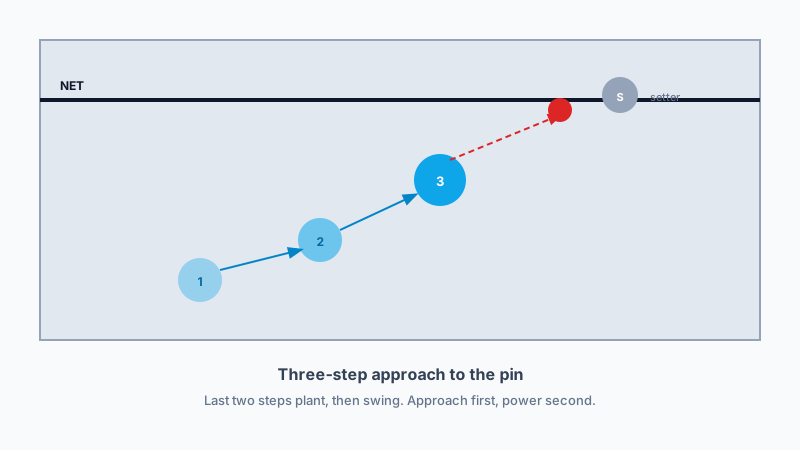
What are volleyball hitting drills? They develop approach footwork, arm swing mechanics, and attack timing. Effective hitters build a consistent three-step or four-step approach before adding power and shot selection. The drills below cover individual technique through live attacking situations.

Volleyball Drills for Hitting

Hitting is the skill players want to practice most, and the one that requires the most structured progression. Approach footwork, arm swing, and timing all need deliberate reps before adding live sets and game pressure.

These volleyball hitting drills are from the SoloCoach library, organized from arm-swing basics through live attacking, tooling the block, and transition hitting.

From the makers of SoloStats

All of these drills are in SoloCoach

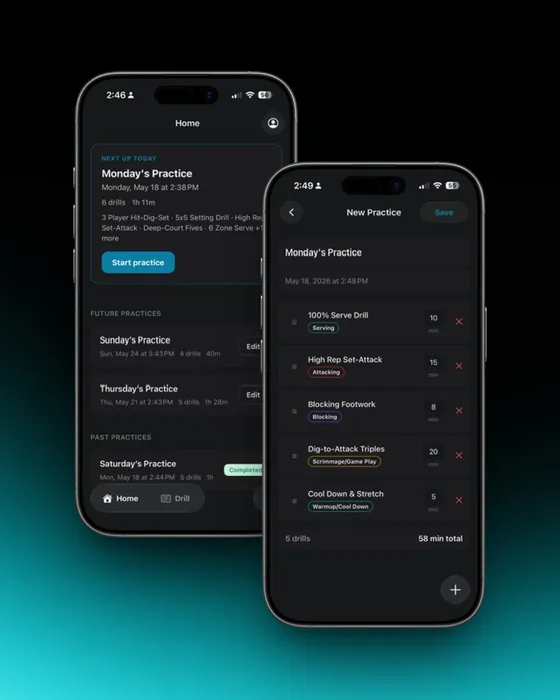
Filter hitting and attacking drills, set time targets, and run your hitting block drill by drill with a countdown timer.

Build your first practice plan, free
SoloCoach app, practice home screen and plan builder

Beginner Hitting Drills

Foundation hitting drills. Use these with youth teams or as the first block of practice.

Wall Hit Drill

1+ playersBalls10 min

Hitters practice their arm swing and contact mechanics against a wall target. No ball toss variability, pure repetition of the hitting motion and contact point.

  1. Mark a target on the wall at approximately 9–10 feet high, 3 feet wide.
  2. Player stands 10–12 feet from the wall with a ball.
  3. Toss the ball slightly in front and above your hitting shoulder, then swing and contact into the target.
  4. The ball will rebound back, catch it and repeat.
  5. Complete 3 sets of 15 reps, focusing on consistent contact point and arm swing path.

Coaching Cues

  • Toss the ball up and slightly forward, do not toss straight overhead, which forces your elbow behind your ear.
  • Swing from high elbow to full extension at contact, elbow leads, hand follows.
  • The wall gives honest feedback: a mis-hit bounces unpredictably. Use it to identify your bad-contact patterns.

Wrist Snap Bounce Drill

1+ playersBalls10 min

Hitters stand at the attack line and smash balls into the floor, focusing on the wrist snap and downward angle that produces topspin and steep attack trajectories.

  1. Player stands at the 3-meter attack line with a supply of balls.
  2. Toss the ball slightly above and in front of your hitting shoulder.
  3. Swing and contact the ball with a sharp wrist snap, driving it into the floor in front of you.
  4. The ball should bounce high and away, a proper snap produces a steep downward angle.
  5. Complete 20 reps focusing on the snap, then transition to the net and apply the same snap in attacks.

Coaching Cues

  • Snap your wrist over the top of the ball, not around it, to produce a downward trajectory.
  • A flat hand at contact produces a flat ball. A snapping wrist produces a steep, hard-to-dig attack.
  • This drill is about feel: close your eyes after 10 reps and focus on what your wrist is doing at contact.

Intermediate Hitting Drills

Reading, placement, and decision-making drills that add game pressure to the hitting foundation.

3 Attacks from 3 Zones

3+ playersBalls10 min

Hitters receive sets from three different zones, outside, middle, and right side, and attack each in sequence. Develops adaptability across approach angles and set types.

  1. Set up a setter at position 2 and a hitter ready at the outside (position 4).
  2. Set 1: high ball to position 4, hitter attacks from the left pin.
  3. Set 2: quick or medium ball to the middle (position 3), hitter shifts and attacks.
  4. Set 3: right-side ball to position 2, hitter attacks from the right pin.
  5. Rotate hitters after one full sequence (3 attacks). Run 3 sequences per hitter.

Coaching Cues

  • Each zone requires a different approach footwork pattern, do not use the same angle for all three.
  • Read the set early: the moment the setter contacts, your feet should already be moving.
  • Attack with intention in each zone, a line hit from position 4, angle from position 2, seam from middle.

High Rep Set-Attack

3+ playersBalls15 min

Hitters take a high volume of consecutive attacks from rapid sets to build muscle memory, arm swing repeatability, and contact consistency under fatigue.

  1. Setter at position 2. Ball shaggers retrieve and feed quickly. One hitter per line.
  2. Setter delivers a steady stream of sets every 6–8 seconds to the same zone.
  3. Hitter approaches and attacks every set, no waiting, no breaks between reps.
  4. Complete 20 consecutive attacks, then rotate the next hitter in.
  5. Focus: consistency of contact point and arm swing, not power.

Coaching Cues

  • Your approach rhythm should be identical every rep, resist the urge to rush or slow down.
  • Contact the ball at the peak of your jump, not on the way up or down.
  • Under fatigue, the arm swing is the first thing to break, stay deliberate through the final rep.

Line Hitting and Tooling the Block

3+ playersBalls10 min

Hitters practice attacking down the line against a set block, then deliberately hitting off the blocker's hands out of bounds. Builds two high-percentage offensive weapons from the same position.

  1. Set up one outside blocker at the left antenna, blocker takes a static position, no movement.
  2. Setter delivers high balls to position 4.
  3. Rep 1: hitter attacks down the line, past the blocker's outside hand.
  4. Rep 2: hitter targets the blocker's outside hand intentionally to tool it out of bounds.
  5. Alternate line and tool reps for 20 total attacks, then rotate.

Coaching Cues

  • Line attack: swing your hitting arm parallel to the sideline, do not open your shoulder to the court.
  • Tooling the block: aim for the outside blocker's hand at the wrist, that angle carries the ball out.
  • Both shots come from the same approach and arm swing, the block cannot tell until your wrist directs it.

Multiple Attack Executions

3+ playersBalls15 min

Hitters cycle through a series of different attack types, line, angle, cut, tip, roll shot, in a structured sequence. Builds a complete offensive toolkit rather than reliance on one swing.

  1. Setter at position 2 delivers high balls to outside hitter at position 4.
  2. Coach calls out an attack type before each set: line, cross-court angle, cut shot, tip, or roll.
  3. Hitter must execute the called attack type, no substitutions.
  4. Run 15 reps, cycling through all 5 attack types at least twice.
  5. Hitters rate themselves after each rep: "I executed that" or "I defaulted to my go-to."

Coaching Cues

  • Shots you never practice become shots you cannot make under pressure, commit to every type.
  • The cut shot and roll shot require wrist control, not arm power, slow your swing down for these.
  • Tip placement: put it 3–4 feet over the block, not 1 foot, too short gets blocked, too long gets dug.

OH Line Angle Hitting Competition

4+ playersBalls15 min

Two outside hitters compete, one hitting line and one hitting angle on alternating sets. First to hit 5 undigable attacks in their assigned direction wins. Sharpens directional precision under competitive pressure.

  1. Two outside hitters alternate: Hitter A always hits line, Hitter B always hits angle.
  2. Setter delivers alternating high balls to each hitter.
  3. A defensive player reads and attempts to dig each attack.
  4. Hitter scores a point for a kill or a ball the defender cannot control.
  5. First hitter to 5 points wins the round. Switch line/angle assignments and repeat.

Coaching Cues

  • Line hitters: stay disciplined, the open angle will tempt you. Trust your assignment.
  • Angle hitters: do not aim for the sideline. Aim for the 5-meter zone inside the right sideline.
  • Both directions benefit from the same arm swing, your wrist angle at contact determines direction.

Rapid Attack Reps Competition

4+ playersBalls10 min

Two hitters race through attack reps as fast as possible, setter feeds both simultaneously from different sides. Competitive speed drill that pushes approach timing and arm swing efficiency.

  1. Two hitting lines: one at position 4 (left outside), one at position 2 (right side).
  2. Two setters (or one setter alternating) deliver sets simultaneously or in rapid alternation.
  3. Hitters attack as fast as the sets come, no standing and waiting.
  4. Count kills made by each line in a 2-minute window.
  5. Line with more kills wins. Rotate players through the lines.

Coaching Cues

  • Stay in your ready position between reps, standing upright between attacks adds a half-second to your approach.
  • A fast drill done sloppily builds bad habits. Keep your approach footwork correct even at speed.
  • Communicate with the setter: if the set tempo is too fast for a clean approach, say so.

Rapid Hitting Competition

4+ playersBalls15 min

A single line of hitters competes to score the most kills in a set number of reps. Fast-paced competitive drill that builds game-speed attacking and mental resilience after errors.

  1. One hitting line at position 4. A setter delivers high balls at game pace.
  2. Each hitter gets 5 consecutive attacks, then rotates out.
  3. Kills score 1 point; errors (in the net, out of bounds) score 0.
  4. Track cumulative scores across all rounds. Run 3 rounds per player.
  5. Final round: each player gets only 3 attacks, pressure round with no warm-up.

Coaching Cues

  • After an error, reset mentally before the next ball, carry a miss into the next swing and you'll make two.
  • Play to your strength on the first rep; go to your secondary shot once the defense adjusts.
  • Keep track of your own score, self-awareness drives improvement better than coach announcements.

Tool Time

3+ playersBalls10 min

Hitters deliberately practice hitting off the block, tooling the blockers' hands out of bounds. A drill entirely focused on one of the highest-percentage offensive weapons in volleyball.

  1. Set up two blockers at the net in a realistic block position at position 4.
  2. Setter delivers high balls to the outside hitter.
  3. Hitter's only objective: hit the ball off the blocker's hands and out of bounds.
  4. Blockers keep their hands up and together, they are targets, not competitors in this round.
  5. Run 15 reps. Count successful tools. Introduce live blocking in Round 2.

Coaching Cues

  • Aim for the outside blocker's outer hand at the wrist, that angle redirects the ball out of bounds.
  • Tooling requires you to swing into the block, not away from it, commit to the contact.
  • If the block is inside (closed), go around it. If it's outside (open), cut it. Read the block at the peak.

Advanced Hitting Drills

Competitive and system-level hitting work for club and high school teams.

Hitter Coverage Smart Hitting into Block

5+ playersBalls15 min

Hitters practice attacking into a 2-person block while teammates execute hitter coverage behind them. Develops block-aware hitting decisions and team coverage discipline simultaneously.

  1. Set up a 2-person block at the net (middle and outside blocker).
  2. Setter feeds sets to the outside hitter, who attacks against the live block.
  3. Three covering teammates position themselves in the hitter coverage triangle behind the hitter.
  4. Hitter reads the block and makes a decision: hit around it, hit off it (tool), or tip over it.
  5. Covering players respond to any blocked ball and keep the play alive.

Coaching Cues

  • Hitters: make your hitting decision based on what you see at the peak, do not pre-decide on the approach.
  • Tooling the block (hitting off the blocker's hands out of bounds) is always a valid option, use it.
  • Coverage players: move to your spot before contact, not after the block lands on the floor.

Hitter's Solo Fight

7+ playersBalls15 min

One hitter takes on a full defensive team (6 players) with a setter feeding sets. The hitter scores for kills; the defense scores for digs and terminations. Builds competitive hitting under real defensive pressure.

  1. Hitter stands at position 4. Full defensive team of 6 sets up on the opposite side.
  2. Setter at position 2 feeds the hitter a steady stream of sets.
  3. Hitter attacks to score points; defense scores for successful digs and cover.
  4. Hitter scores 2 for a kill, 1 for hitting in-bounds without a dig. Defense scores 1 for each dig.
  5. Play to 10 points, then rotate a new hitter in.

Coaching Cues

  • Hitter: the defense knows exactly where you're hitting from. Make them wrong about where you aim.
  • Use off-speed shots and tips when blockers are set, do not try to overpower a good block.
  • Defense: no pre-positioning before contact; read the hitter, don't guess.

Middle Hitter Footwork 3 Different Sets

3+ playersBalls10 min

Middle hitters practice their footwork pattern for three distinct set tempos: quick (1-ball), medium (2-ball), and high (3-ball). Builds the footwork adaptability that separates elite middles from average ones.

  1. Setter at position 2. Middle hitter starts in blocking position at the net.
  2. Round 1: setter delivers quick 1-balls, hitter must plant and swing immediately.
  3. Round 2: setter delivers medium-tempo 2-balls, hitter takes a modified 2-step approach.
  4. Round 3: setter delivers slower, higher 3-balls, hitter takes a full 4-step approach.
  5. Run 5 reps of each tempo, then rotate. Coach calls out the set type just before delivery.

Coaching Cues

  • Quick sets require your jump to be already in motion before the setter contacts, trust the timing.
  • Never use the same footwork for all 3 tempos; adapting your steps to the set tempo is the whole drill.
  • Eyes on the setter's hands through the plant step, the set's location tells you your final step direction.

Middle Quick Transition Attack Footwork

3+ playersBalls10 min

Middle blockers practice transitioning from a block position to an approach angle for a quick attack. Isolates the footwork pattern that allows middles to be an offensive threat immediately after blocking.

  1. Middle hitter starts at the net in a blocking position (hands above the net).
  2. On coach's signal, hitter drops off the net, takes transition steps back and to the approach angle.
  3. Setter delivers a quick or medium set to the middle.
  4. Hitter plants and attacks in one continuous motion from the transition.
  5. Run 10 reps, alternating which side of the middle the approach originates from.

Coaching Cues

  • Your first step off the net should be backward and sideways, not straight back, which kills your angle.
  • Transition fast: the quick set doesn't wait for slow footwork.
  • Land from the block and immediately transfer your weight to the approach, do not pause at the net.

Pipe Attack Drill

3+ playersBalls10 min

Back-row players practice the pipe attack, a back-row attack from the center, with a setter delivering sets designed for the back-row approach and jump from behind the attack line.

  1. Back-row player starts at the center back position (pipe zone), 12–15 feet behind the net.
  2. Setter at position 2 delivers a high, slightly off-the-net set to the pipe zone.
  3. Back-row player takes a full approach, must jump from behind the 3-meter line.
  4. Attack the ball aggressively into the open court, target deep corners.
  5. Run 10 reps per player, then rotate. Add a blocker for realism after the first 5 reps.

Coaching Cues

  • Your jump must start completely behind the 3-meter line, a foot fault is a point given away.
  • Pipe sets should be high to give you time to approach; a flat, fast set from a tired setter is not your fault.
  • Aim for deep corners: the pipe angle opens up cross-court and line shots from center back.

Sharp Angle One Set Attack

2+ playersBalls10 min

Hitters practice the sharp cross-court cut shot, a high-difficulty, low-percentage shot that, when mastered, becomes an untouchable weapon. Isolated practice builds the wrist control required.

  1. Setter delivers high balls to position 4. No blockers, no defense initially.
  2. Hitter focuses exclusively on the sharp cut angle, targeting the deep corner on the same side as their approach.
  3. Coach places a cone in the target zone (deep right corner from a left-side approach).
  4. Complete 15 reps targeting the cone. Track how many land within 3 feet of it.
  5. Add a blocker in Round 2, the cut shot must go over or around the block.

Coaching Cues

  • The cut shot requires your arm to swing across your body at contact, your hitting shoulder crosses your chin.
  • Do not open your hips toward the sharp angle early; the block reads hip rotation before you swing.
  • This is a wrist shot, not a power shot, control over the ball's direction matters more than pace.

How to Progress Your Hitting Training

  1. Step 1

    Start with contact, not the approach. Wall Hit Drill and Wrist Snap Bounce Drill isolate the arm swing and downward contact. Power without a snap just puts the ball out.

  2. Step 2

    Add location next. High Rep Set-Attack, 3 Attacks from 3 Zones, and Line Hitting and Tooling the Block teach hitters to swing to a spot, line, angle, or tool, instead of swinging as hard as they can.

  3. Step 3

    Finish with decisions. Rapid Hitting Competition, Hitter Coverage Smart Hitting into Block, and Pipe Attack Drill add a live block or transition. Shot selection under pressure is the skill that shows up in matches.

  4. Step 4

    Hitting quality depends on setting. Pair these with setting drills so hitters see real balls, not only coach tosses.

Volleyball Hitting Drills, Frequently Asked Questions

What are the best volleyball hitting drills for beginners?
Wrist Snap Bounce Drill and Wall Hit Drill. Both teach arm swing and contact without a live set. Add a tossed ball and a three-step approach only after the snap and contact point are consistent.
How do you teach a hitting approach?
Break it into steps on the ground first: last two steps, plant, then swing. Middle Hitter Footwork and Pipe Attack Drill add approach patterns once the plant is balanced. Do not add a jump until the footwork is quiet.
How do you teach hitters to tool the block?
Use Line Hitting and Tooling the Block and Tool Time. Cue “hands, then seam.” Hitters who only swing at the court never learn to use the block as a scoring surface.
How long should a hitting block last?
Fifteen to twenty-five minutes. Shoulders fatigue. Rotate groups so players are not swinging continuously, and mix in a location competition rather than a full half-hour of max-effort spikes.
When should you add transition hitting?
After pin attacks from a live set are in. Middle Quick Transition Attack Footwork and Pipe Attack Drill train the next layer, hitting after a defensive contact, not only from a tossed ball in a hitting line.
    Volleyball Drills for Hitting, Approach, Timing & Power | SoloCoach