What is out of system in volleyball? Out of system means the first contact is too tight, off target, or late for your primary offense, so the team calls it, the setter delivers a high ball to the outside or opposite, and hitters slow their approach. Out-of-system drills train recognition, the setter box, and composed attacking instead of forcing a broken quick.

Volleyball Out-of-System Drills

This page covers volleyball out of system offense and the drills that train it: recognition, high delivery, and hitter adjustments under imperfect passes.

Pair these with high school transition work and setting drills. The goal of an out-of-system rally is a hittable high ball that keeps the point alive, not a highlight kill off a broken pass.

When to run this page

Use this hub when your team forces quicks on bad passes, freezes on tight balls, or loses composure after a seam serve. Best for club 14s+ and high school. Budget 15–20 minutes after serve receive; do not open practice with full out-of-system 6v6.

High school hub owns broader transition offense. This page is the definition + box-offense home for “volleyball out of system” searches.

Call “out” early: recognition beats a perfect set on a doomed quick.
Hitters must hear the call and change the approach. Same footwork on a broken pass is how you tool your own block.
Score the drill on clean recognition + hittable high ball, not kill percentage.
Volleyball out-of-system box setup, setter delivering high ball to outside hitter
Bad pass → call out → high set to the pin → delayed approach.

From the makers of SoloStats

Build an out-of-system block in SoloCoach

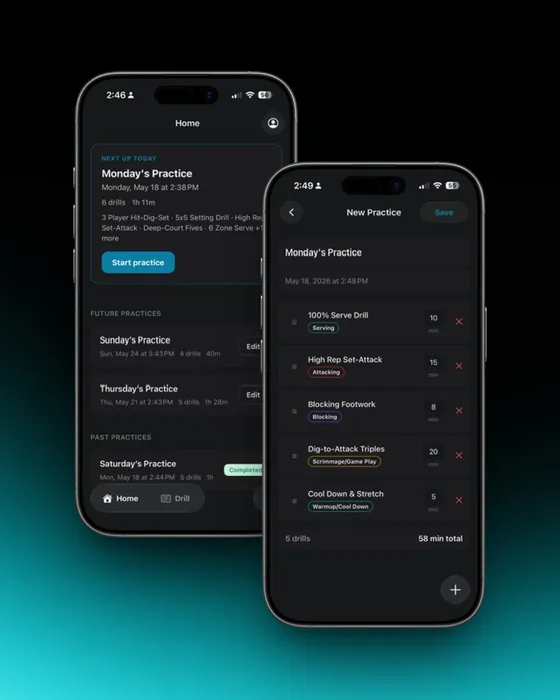
Add recognition and box drills to a timed plan, then run them with a countdown so the call happens before the set.

Build your first practice plan, free
SoloCoach app, practice home screen and plan builder

Recognize and Call Out-of-System

The rally is saved when someone calls “out of system” early. These drills force bad first contacts and a clear box offense.

Box for Out-of-System

6+ playersBalls15 min

Team practices a structured "box" offensive system when the pass is off-target or the setter is out of position. Builds composure and a reliable fallback offense when the first ball is poor.

  1. Coach intentionally tosses or hits bad balls, seam balls, tight passes, overpasses, that put the team out of system.
  2. Team must recognize "out of system" immediately and shift to the box: setter sets high to outside or opposite.
  3. Hitters recognize the out-of-system call and adjust their approach to a slower, higher set.
  4. Run 10 out-of-system reps. Coach evaluates: did the team recognize it and adjust, or did they try to run their primary offense?
  5. Debrief after each rep: who called it? Was the transition clean?

Coaching Cues

  • Recognizing out-of-system early is more valuable than a great set, call it loudly so everyone adjusts.
  • Hitters: do not try to hit a quick ball on a bad pass. Slow down, read the set, adjust your approach.
  • The box exists to keep the rally alive, not to win the point, a hittable high ball is a success.

Net Ball Recovery Sets

3+ playersBalls10 min

Coach intentionally sends balls that clip or drop off the net. Setter must recover the ball and still deliver a usable set. Builds composure and creative ball-handling in broken situations.

  1. Coach stands at the net and pushes or drops balls that clip the tape or dribble over.
  2. Setter sprints in from position 2 and attempts to recover the ball.
  3. Setter delivers whatever set is possible, outside, dump, back-set, to keep the play alive.
  4. Hitter or coach evaluates: was the recovery set hittable?
  5. Run 10 reps per setter. Increase difficulty by varying the drop height and angle.

Coaching Cues

  • Sprint to the net immediately, hesitation means the ball hits the floor before you arrive.
  • Use your hands if the ball is high enough; forearm bump-set if it's too low for hands.
  • Any set that gives a hitter a swing is a successful recovery, perfection is not the goal here.

Setter Box and High Delivery

When the pass is off, the setter’s job is a high, hittable ball to the pin — not a forced quick.

Deep 2 Set and Hit

3+ playersBalls10 min

Setter delivers sets from a deep position (behind position 2, toward the center) to practice setting while off-balance or out of system. Hitters complete the rep by attacking.

  1. Coach tosses balls intentionally deep, past the setter's ideal position, forcing them to retreat.
  2. Setter back-sets or jump-sets from a deep, non-ideal position to an outside or right-side hitter.
  3. Hitter approaches and attacks the set.
  4. Focus is on the setter making a quality decision from a difficult spot, not on the attack.
  5. Run 10 reps, rating each set: Did the hitter get a ball they could attack effectively?

Coaching Cues

  • When deep, a back-set to the right side is often the highest-percentage choice, know your options before the ball arrives.
  • Jump-setting from a deep position keeps the ball higher and gives hitters more time to approach.
  • Do not try to set a perfect ball from a terrible position, a makeable set beats a highlight-reel attempt.

Single Setter Double Sided Deep Sets

3+ playersBalls10 min

Setter delivers deep back-row sets to both sides of the court from a central position, developing the ability to set pipe and back-row attack options with precision.

  1. Setter stands at position 2. Two back-row hitters position themselves at pipe (center back) and right back.
  2. Coach feeds balls to the setter with passes of varying quality.
  3. Setter alternates: one pipe set, one right-back set, repeat.
  4. Back-row hitters approach from 10 feet behind the attack line and jump-attack.
  5. Focus: the setter must adjust the set height and tempo based on the approach speed of the back-row attacker.

Coaching Cues

  • Back-row sets need to be higher and farther off the net than front-row sets, give the hitter time.
  • Call the back-row set early so the hitter can begin their approach from deep.
  • You cannot back-set to the pipe, use a front-set with a slight arc toward center back.

Hitter Adjustments and Transition

Hitters slow the approach, read a higher set, and still finish — including dig-to-attack transitions that often start out of system.

Transition Hitting Into Zones with Blocking

6+ playersBalls15 min

Hitters transition from a defensive position, receive a set, and attack against a live block, targeting specific court zones. Combines transition footwork with zone-awareness hitting against real opposition.

  1. Hitter starts in a back-row defensive position. Two blockers set up at the net.
  2. Coach attacks at the hitter, who digs and then immediately transitions to an approach.
  3. Setter delivers a set. Hitter attacks against the live block, targeting a called zone.
  4. Coach calls the target zone (line, angle, or seam) at the moment of the set.
  5. Run 10 reps per hitter. Rotate blockers every 5 reps.

Coaching Cues

  • The transition footwork sets up your attack, if you arrive at your approach with bad momentum, you're already compromised.
  • Read the block at the peak of your jump, the zone call gives you direction, but the block tells you where to actually go.
  • Blocking players: be realistic. Give the hitter real looks, not charity blocks.

Middle Quick Transition Attack Footwork

3+ playersBalls10 min

Middle blockers practice transitioning from a block position to an approach angle for a quick attack. Isolates the footwork pattern that allows middles to be an offensive threat immediately after blocking.

  1. Middle hitter starts at the net in a blocking position (hands above the net).
  2. On coach's signal, hitter drops off the net, takes transition steps back and to the approach angle.
  3. Setter delivers a quick or medium set to the middle.
  4. Hitter plants and attacks in one continuous motion from the transition.
  5. Run 10 reps, alternating which side of the middle the approach originates from.

Coaching Cues

  • Your first step off the net should be backward and sideways, not straight back, which kills your angle.
  • Transition fast: the quick set doesn't wait for slow footwork.
  • Land from the block and immediately transfer your weight to the approach, do not pause at the net.

Pipe Attack Drill

3+ playersBalls10 min

Back-row players practice the pipe attack, a back-row attack from the center, with a setter delivering sets designed for the back-row approach and jump from behind the attack line.

  1. Back-row player starts at the center back position (pipe zone), 12–15 feet behind the net.
  2. Setter at position 2 delivers a high, slightly off-the-net set to the pipe zone.
  3. Back-row player takes a full approach, must jump from behind the 3-meter line.
  4. Attack the ball aggressively into the open court, target deep corners.
  5. Run 10 reps per player, then rotate. Add a blocker for realism after the first 5 reps.

Coaching Cues

  • Your jump must start completely behind the 3-meter line, a foot fault is a point given away.
  • Pipe sets should be high to give you time to approach; a flat, fast set from a tired setter is not your fault.
  • Aim for deep corners: the pipe angle opens up cross-court and line shots from center back.

How to Progress Out-of-System Training

  1. Step 1

    Teach the language first. Every player must know what “out” means and who is allowed to call it (usually the setter or libero).

  2. Step 2

    Isolate the box. Feed intentionally bad balls and require a high outside or opposite set before any live block.

  3. Step 3

    Add hitter adjustments. Hitters start in transition or a freeze position and must change approach tempo to the higher set.

  4. Step 4

    Live it under serve pressure. Combine with serve receive so the broken pass is match-realistic, then finish with a scored constraint: only out-of-system sideouts count.

Volleyball Out-of-System, Frequently Asked Questions

What is out of system in volleyball?
Out of system means the pass or first contact is not good enough to run your designed offense. The team calls it, shifts to a high “box” set to the pin, and hitters adjust to a slower approach so the rally stays alive.
What does out of system volleyball mean for the setter?
The setter stops hunting quicks and middles on a broken pass. Priority is a high, hittable ball to the outside or opposite, even from a deep or off-balance platform, so the hitter has time to approach.
What are the best volleyball out of system drills?
Box for Out-of-System for recognition, Deep 2 Set and Hit for high delivery, and Transition Hitting Into Zones for dig-to-attack adjustments. Score recognition and hittable sets before you score kills.
When should youth teams learn out-of-system offense?
After they can pass a tossed ball to target and understand a basic sideout. Keep the vocabulary simple (“high outside”) before full box systems. Younger teams often need serve-receive volume more than out-of-system complexity.
How is out-of-system different from transition offense?
Transition is attacking after a dig or free ball in general. Out-of-system is specifically when the first contact is too poor for the primary play. Many transition attacks are in-system; this page trains the broken-pass case.
    Volleyball Out-of-System Drills & Offense | SoloCoach