What are junior high volleyball drills? They build first-contact consistency and rally length before teaching systems. The best middle-school practices spend most of the gym time on passing, serving, and small-court games — not 6v6 with three players standing still. Use 12–15 minute blocks so every player keeps touching the ball.

Junior High Volleyball Drills

Junior high teams sit between rec beginners and high school systems. Players can pass a tossed ball, but serve receive, serve placement, and game-like attacking are still new. A 75–90 minute practice that copies a varsity plan will lose the room.

These junior high volleyball drills are from the SoloCoach library. They mix beginner fundamentals with selected intermediate work: passing lanes, zone serving, short-court triples, and king of the court. Advanced transition offense and libero systems stay off this page.

Run passing and serving first. Add a small-court game before anyone asks to scrimmage full court. When pass quality holds in Short-Court Triples, you can steal a drill from the high school hub — not before.

From the makers of SoloStats

Build a junior high practice in SoloCoach

Filter by skill, set 12–15 minute blocks, and run the plan from your phone so the gym keeps moving.

Build your first practice plan — free
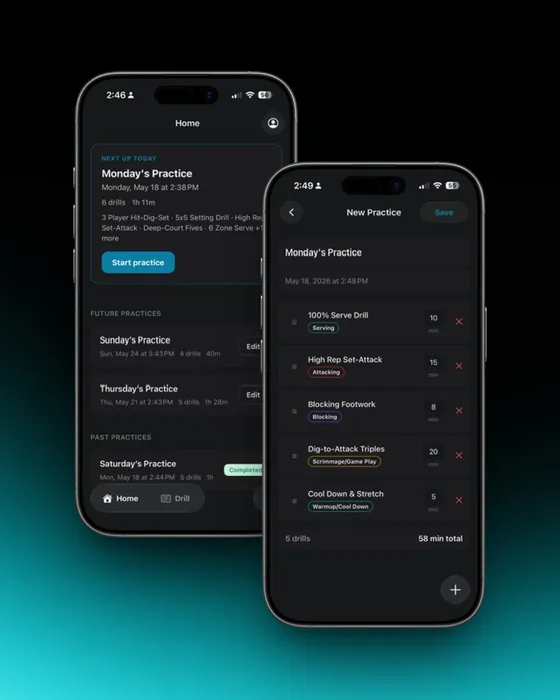
SoloCoach app — practice home screen and plan builder

Junior High Fundamentals

High-rep passing and serving that keep every player touching the ball. Use these in the first half of a 75–90 minute practice.

Pairs Passing Game

2+ playersBalls10 min

Two players face each other and pass continuously, counting consecutive passes. A simple high-repetition drill to build platform fundamentals and rhythm.

  1. Partners stand 8–10 feet apart facing each other.
  2. One player initiates with a controlled underhand toss.
  3. Pass back and forth, counting consecutive passes without the ball hitting the floor.
  4. When the ball drops, reset and try to beat your previous record.
  5. Gradually increase distance to 15 feet as control improves.

Coaching Cues

  • Platform should be set before the ball arrives — no scooping or last-second arm swings.
  • Use your legs to generate direction; your arms are a platform, not a swing.
  • Aim every pass at your partner's chest — consistency builds confidence.

Bounce Pass Hit

2+ playersBalls10 min

A foundational drill where partners toss a ball, let it bounce, and then pass it on the second bounce. Slows down the contact moment to help beginners build platform mechanics.

  1. Partners stand 8–10 feet apart facing each other.
  2. Player A bounces the ball firmly on the floor toward Player B.
  3. Player B lets the ball bounce once, then passes it back on the rise using a forearm platform.
  4. Alternate roles after every 5 passes.
  5. Progress by reducing the bounce height and increasing the pass speed.

Coaching Cues

  • Get behind the ball and low before it bounces — don't reach for it as it rises.
  • Contact the ball on the way up, not at the peak — the rising ball gives you more control.
  • Keep your elbows straight and platform flat; this is all about the shape of your arms.

180 Pass Drill

2+ playersBalls10 min

Partners stand back-to-back, toss the ball overhead, then spin 180 degrees and pass the incoming ball to their partner. Trains quick platform setup after sudden body rotation.

  1. Partners stand back-to-back about 6 feet apart, each holding a ball.
  2. Player A tosses the ball straight up overhead, then spins 180 degrees to face Player B.
  3. Player B tosses simultaneously, spins to face Player A, and passes the incoming ball back.
  4. Continue alternating tosses and passes — keep the rhythm steady and controlled.
  5. Progress to faster tosses and quicker spins as accuracy improves.

Coaching Cues

  • Spin fast but stop your feet before contacting — passing while still rotating kills accuracy.
  • Get your platform set and angled before the ball arrives, not during contact.
  • Stay low through the spin; standing upright on the rotation slows your setup time.

Passing Lanes

4+ playersBalls, Cones10 min

Cones define narrow passing lanes on the court. Passers must direct every pass through their assigned lane to develop accuracy and intentional platform angles.

  1. Set up cones to define 3 passing lanes across the back court (left, middle, right).
  2. Coach or server sends balls to various spots in the back court.
  3. Passer must pass the ball through their assigned lane — not just up, but directionally accurate.
  4. Rotate which lane each passer is assigned every 5 passes.
  5. Track how many passes land within the target lane vs. outside it.

Coaching Cues

  • Platform angle is your steering wheel — twist your platform face toward the target lane before contact.
  • You cannot aim a pass if you're still moving at contact; stop your feet first.
  • Passing accurately to a lane is harder than passing to a person — demand precision.

Chaos Passing

4+ playersBalls10 min

Coach simultaneously tosses multiple balls from different angles and heights. Players must communicate, move, and pass in rapid succession with no predictable rhythm.

  1. Position 4 players spread across the back row in base defensive positions.
  2. Coach stands at the net with a cart of balls and begins tossing them unpredictably — varying angle, depth, and pace.
  3. Players call "mine" immediately and pass each ball to the setter target.
  4. Coach does not wait for each pass to land — next ball goes immediately.
  5. Run for 60 seconds, then rest. Track total passes and quality.

Coaching Cues

  • Communication is the drill — the first player to call "mine" owns the ball, no debate.
  • Stay in your base position between balls; drifting creates gaps and collisions.
  • Short, controlled passes beat big heroic digs — stay compact under pressure.

Wall Serving Drill

1+ playersBalls10 min

Players practice their serving motion against a wall target, focusing on arm swing mechanics, wrist snap, and contact point without the variability of a full-court setup.

  1. Mark a target zone on a flat wall at net height (approximately 7.5 feet from the floor).
  2. Player stands 20–25 feet from the wall and serves into the target.
  3. Focus on a consistent ball toss, full arm extension, and firm contact.
  4. Complete 3 sets of 10 serves each, resting 30 seconds between sets.
  5. Vary serve type: alternate float serves (no follow-through) and topspin serves (wrist snap over).

Coaching Cues

  • The wall gives instant feedback — a weak arm swing produces a ball that falls short; fix the swing.
  • Toss the ball slightly in front of your hitting shoulder, not directly overhead.
  • Stand still during the toss — stepping forward before your arm swings disrupts your contact point.

6 Zone Serve

1+ playersBalls, Cones10 min

The court is divided into 6 numbered zones. Coach calls a zone number and the server must target it immediately. Develops serve placement on command and builds court spatial awareness.

  1. Divide the opposite court into 6 zones with cones: 3 deep (1, 2, 3) and 3 short (4, 5, 6).
  2. Server stands at the baseline with a supply of balls.
  3. Coach calls a zone number just before the server begins their serving motion.
  4. Server must land the ball in the called zone.
  5. Track hits vs. misses per zone to identify weaker placement areas.

Coaching Cues

  • Know where all 6 zones are before you start — hesitating on the zone number costs you your toss.
  • Adjust your body angle slightly toward the target zone before your toss, not after.
  • Beginners: master the deep zones first. Short serves require precise net clearance and are harder to control.

100% Serve Drill

1+ playersBalls, Cones10 min

Players serve to a specific target zone and must hit it 100% of the time before moving on. Eliminates casual serving by demanding complete accuracy on every rep.

  1. Place a cone or hula hoop in a target zone on the opposite court — start with a large zone.
  2. Player serves 5 consecutive balls with the goal of hitting the target every time.
  3. If any serve misses, the count resets to 0.
  4. Once 5 in a row land in the large zone, reduce the target size or move it to a harder location.
  5. Track personal records for each target zone across sessions.

Coaching Cues

  • Pick your target before your toss — serving without a destination is just hitting.
  • A miss resets the count; embrace the pressure rather than rushing to get back on track.
  • Consistent toss height and location is the foundation of consistent serves — fix the toss first.

Tic-Tac-Toe Serve Game

2+ playersBalls, Cones15 min

A 3x3 grid is marked on the court. Two players or teams compete to land serves in 3 squares in a row before the opponent, combining serve placement precision with competitive strategy.

  1. Mark a 3x3 grid of 9 target zones on the opposite court using cones or floor tape.
  2. Two players alternate serves, each trying to land in a zone of their choice.
  3. If a serve lands in the target zone, that square is claimed (track with a system — cones, colors, etc.).
  4. First player to claim 3 in a row (horizontal, vertical, or diagonal) wins.
  5. If all 9 squares are claimed without a winner, play a tiebreak set of 5 serves to the hardest square.

Coaching Cues

  • Think two serves ahead — block your opponent's winning line before going for your own.
  • Corner zones are the most strategically valuable; claiming two corners early limits opponent options.
  • A missed serve is a missed turn — accuracy is your strategy, not just your technique.
Junior High Games and Hitting

Small-court games and simple attacking so rallies stay alive. Skip full 6v6 until pass and serve are consistent.

Short Court Game

4+ playersBalls15 min

Teams compete on a shortened court (front half), emphasizing net play, tips, roll shots, and sharp angles. Removes back-row defense and isolates front-court skills in a game format.

  1. Use only the front half of the court — from the net to the attack line on each side.
  2. 2v2 or 3v3. All plays must land between the net and the attack line.
  3. Attacks that land past the attack line are out. Ball must go over the net on every contact.
  4. Normal rally scoring to 15.
  5. Focus: tips, roll shots, sharp angles, and net plays — power attacks go out on a short court.

Coaching Cues

  • Soft hands win on a short court — attacking hard lands out of bounds every time.
  • Tips should land 2–3 feet past the net, not 6 inches. Short tips are easy to dig.
  • Front-court defense means being up, alert, and ready to move forward at all times.

Split Court Doubles Games

4+ playersBalls15 min

Standard 2v2 competition on a split half-court. Compact format that maximizes contacts per player and forces every player to be involved in every phase of play.

  1. Split the court into two long, narrow halves. Two pairs compete simultaneously on each half.
  2. Standard 2v2 volleyball rules — 3 contacts per side, rally scoring.
  3. One player serves from the baseline. Alternate serve every 5 points.
  4. Play to 15 points. Rotate partners between games to expose players to different dynamics.
  5. Coaching points: communication, role clarity (who sets, who hits), and defensive coverage.

Coaching Cues

  • Communicate your role before every ball: "I've got it" or "yours" — no silent duos.
  • On offense: the non-attacking player must cover behind the hitter immediately.
  • On defense: split the court — each player owns one side. No drifting into your partner's zone.

Short-Court Triples

6+ playersBalls20 min

Three-player teams play on a shortened court emphasizing ball control, quick transitions, and three-contact discipline. Ideal for developing touch and system play in a compact format.

  1. Mark a court from the net to halfway between the attack line and the net.
  2. 3v3 teams compete. All three contacts are mandatory — no two-contact plays allowed.
  3. Ball must clear the net by at least 1 foot — touching the net is a fault.
  4. Rally scoring to 15. Rotate server after each side-out.
  5. Coaching emphasis: pass → set → swing, every time, every rally.

Coaching Cues

  • Three contacts are mandatory — even on a perfect overpass, you must still set and swing.
  • Sets should be 2–3 feet off the net, not tight to the tape — tight sets limit hitting angles on a short court.
  • With 3 players covering a short court, someone is always open — find them with your attack.

King/Queen of the Court

6+ playersBalls20 min

Players compete to hold the "king/queen" position on one side of the net. Winners stay; losers rotate to the challenger side. Builds competitive intensity and consistency under pressure.

  1. One team holds the "king" side. Challengers line up on the other side.
  2. Coach initiates each rally with a free ball or serve.
  3. King side wins: stays and a new challenger team rotates in. Challenger wins: moves to king side.
  4. A team that holds the king position for 5 consecutive rallies wins that round.
  5. Vary team size (2v2, 3v3, 6v6) based on available players and focus skill.

Coaching Cues

  • King side: complacency is the enemy. Stay sharp — every challenger team is fighting harder than you.
  • Challengers: urgency wins. Play every rally like it's match point because it is.
  • Coach: vary who serves first and what type of ball initiates play.

High Rep Set-Attack

3+ playersBalls15 min

Hitters take a high volume of consecutive attacks from rapid sets to build muscle memory, arm swing repeatability, and contact consistency under fatigue.

  1. Setter at position 2. Ball shaggers retrieve and feed quickly. One hitter per line.
  2. Setter delivers a steady stream of sets every 6–8 seconds to the same zone.
  3. Hitter approaches and attacks every set — no waiting, no breaks between reps.
  4. Complete 20 consecutive attacks, then rotate the next hitter in.
  5. Focus: consistency of contact point and arm swing, not power.

Coaching Cues

  • Your approach rhythm should be identical every rep — resist the urge to rush or slow down.
  • Contact the ball at the peak of your jump, not on the way up or down.
  • Under fatigue, the arm swing is the first thing to break — stay deliberate through the final rep.

How to Structure a Junior High Volleyball Practice

  1. Step 1

    Open with pairs passing or pepper, then a serving block with a target (6 Zone Serve or Tic-Tac-Toe). First contact still decides whether the rest of practice is real volleyball.

  2. Step 2

    Add one intermediate passing drill — Passing Lanes or Chaos Passing — so players move to the ball instead of catching tossed balls in a line.

  3. Step 3

    Finish with a small-court game. Short Court, Split Court Doubles, or King/Queen of the Court give more contacts than 6v6. Save High Rep Set-Attack for the last skill block if arms are fresh.

  4. Step 4

    If you need serve-receive under a live serve, use the serve-receive hub. Do not replace this page’s passing work with a full 6-person receive formation until the platform is stable.

Junior High Volleyball Drills — Frequently Asked Questions

What are the best volleyball drills for junior high?
Pairs Passing Game, 180 Pass Drill, 6 Zone Serve, Short Court Game, and King/Queen of the Court. They keep touches high and skip rotational systems until pass and serve hold up.
How long should a junior high volleyball practice be?
Seventy-five to ninety minutes. Use 12–15 minute blocks. If attention drops, switch to a small-court game instead of adding another lecture.
Should junior high teams scrimmage 6v6 every practice?
Not as the main block. 6v6 hides the players who need reps. Short-Court Triples and Split Court Doubles keep more people in the rally. Add a short 6v6 only after first contact is playable.
What skills should junior high volleyball practice emphasize?
Passing and serving first — about half the gym time. Then one other skill (setting or hitting) and a small-sided game. Systems and libero specialization wait until high school.
How are junior high drills different from beginner drills?
Beginner drills isolate one contact with a toss. Junior high drills add movement, targets, and small-court scoring — Passing Lanes, 100% Serve Drill, King/Queen of the Court — without varsity transition offense.
    Junior High Volleyball Drills — Passing and Serving | SoloCoach