What are high school volleyball drills? They train match skills: serve receive, transition offense, and competitive 6v6 constraints. A varsity practice should score the thing you want in the next match — sideout, stuff blocks, or out-of-system swings — not a line of tossed hitting.

High School Volleyball Drills

High school gym time is usually 90–120 minutes. That is enough for a first-contact block, a systems block, and a scored game. It is not enough to run every skill every day. Pick the match problem and train it with live balls.

These volleyball drills for high schoolers are from the SoloCoach library. They skip beginner wall work. Serve receive, net serving, transition hitting, out-of-system boxes, and wash-style games (Columbus, Sideout to Win, U.S.A. Drill) are the core.

If your JV still cannot pass a float serve, use the junior high hub for the first 30 minutes, then steal one competitive drill from this page. Varsity can live here the whole practice.

From the makers of SoloStats

Build a high school practice in SoloCoach

Filter by skill, set 20-minute blocks, and run serve-receive into transition into a scored game without rewriting the plan on a whiteboard.

Build your first practice plan — free
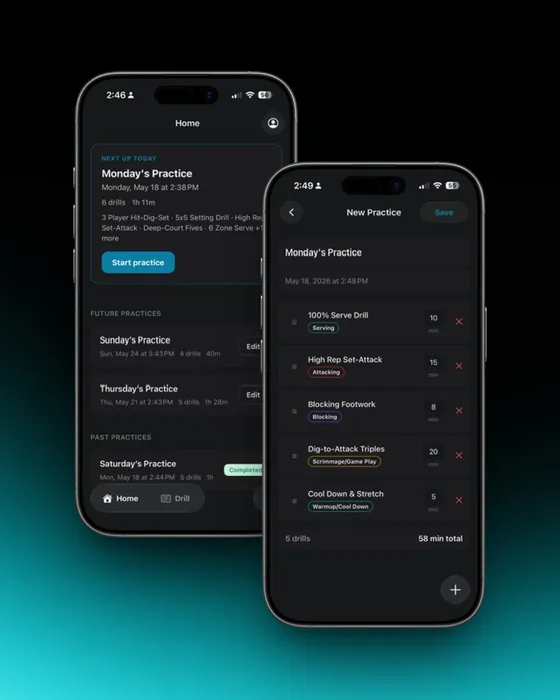
SoloCoach app — practice home screen and plan builder

High School First Contact and Serving

Serve-receive and serve pressure that show up in matches. Pair these with the dedicated serve-receive hub for a full first-contact block.

Butterfly Serve and Receive

8+ playersBalls15 min

A continuous movement drill where servers, passers, and shagging players rotate through stations in a butterfly pattern. Builds serve-receive repetitions at high volume with built-in movement.

  1. Set up two serving lines at opposite baselines and two passing zones on each side of the net.
  2. Server serves, then follows the ball by running around the net to the opposite passing zone.
  3. Passer receives the serve, passes to a target, then follows their pass to the back of the serving line.
  4. Keep the flow continuous — as soon as a pass is made, the next server goes.
  5. Coach monitors pass quality; call out the score (1–3) for each pass as play flows.

Coaching Cues

  • Passers: get to your spot before the serve crosses the net — late movement kills your platform angle.
  • Keep the butterfly moving — a slow rotation breaks rhythm and reduces reps.
  • Servers: vary serve type and location; do not just lob the same ball every time.

Team Receive Drill

6+ playersBalls15 min

Full team runs their serve-receive formation against a live server. Emphasizes system execution, communication, and consistent pass quality across the full rotation.

  1. Set the full team in their serve-receive formation for a specified rotation.
  2. Server serves from the baseline, varying serve type and location.
  3. Passers call balls early and pass to the setter target.
  4. Setter catches or sets the second ball — focus is on the pass quality to zone 2.
  5. After 10 serves, rotate one position and repeat.

Coaching Cues

  • The first call (mine / yours) must happen before the ball crosses the net — not after.
  • Non-passers: stay in position and ready to help on seam balls — no standing and watching.
  • Setter: give verbal feedback on pass quality immediately — "good pass" or "I had to move" keeps standards high.

Net Serve Drill

1+ playersBalls10 min

Players deliberately practice serves that just barely clear the net, learning to control net clearance and produce low, harder-to-pass float serves.

  1. Player serves from the baseline targeting a low trajectory — aim to clear the net by less than 1 foot.
  2. Each serve must land in bounds. Serves that clip or hit the net don't count.
  3. Complete 3 sets of 10 serves each, tracking how many clear low and land in.
  4. Shift target zones each set: left deep, right deep, center short.
  5. Progress goal: 7 of 10 clearing low and landing in per set.

Coaching Cues

  • Lower trajectory comes from a higher contact point, not hitting harder — reach up, not through.
  • Float serves need a firm, flat contact with no follow-through; the wrist stops at contact.
  • A serve that clears by 3 inches and lands in is 10x harder to pass than one that clears by 3 feet.

High School Offense, Blocking, and Defense

Transition offense, shot selection, and team defense. These are 90–120 minute practice building blocks, not youth progressions.

Continuous Pass-Set-Hit 3s

3+ playersBalls10 min

Three-player groups run continuous pass-set-hit sequences without stopping. All three roles rotate after a set number of contacts. High-volume offensive repetition in a minimal-player format.

  1. Three players: Passer (back row), Setter (front row position 2), Hitter (outside).
  2. Passer self-tosses or coach tosses; passer passes to setter.
  3. Setter delivers a set to the hitter. Hitter attacks (controlled — aim for open floor, not full power).
  4. After 5 complete sequences, rotate: Hitter → Setter → Passer → Hitter.
  5. Count sequences without an error. Target: 10 clean sequences before rotating.

Coaching Cues

  • Keep the pace steady — rushing to the next rep before recovering from the last one produces errors.
  • Setters: arrive at position 2 before the pass reaches you, not at the same time.
  • Hitters: after attacking, immediately move to the passer position — no standing and watching.

Set Distribution Drill

4+ playersBalls10 min

Setter practices distributing sets across all available hitters in a structured sequence, then on coach's call. Develops decision-making and the ability to go to any option under pressure.

  1. Position hitters at outside (4), right side (2), and middle (3). Setter at position 2.
  2. Round 1: setter runs through a predetermined sequence — 4, 2, 3, 4, 2, 3 — without signals.
  3. Round 2: coach calls out a hitter's number just as the ball is fed — setter must deliver to the called option.
  4. Round 3: setter calls their own distribution, mixing all three options.
  5. Run 15 sets per round, rating each on hitter feedback: "I could attack that" or "I couldn't."

Coaching Cues

  • Square your hips to the same spot (outside) on every set — do not aim your body at the hitter you're targeting.
  • In Round 2, trust your reaction: overthinking on the called number causes late, flat sets.
  • A good setter makes every hitter feel like the first option — distribute with conviction.

Line Hitting and Tooling the Block

3+ playersBalls10 min

Hitters practice attacking down the line against a set block, then deliberately hitting off the blocker's hands out of bounds. Builds two high-percentage offensive weapons from the same position.

  1. Set up one outside blocker at the left antenna — blocker takes a static position, no movement.
  2. Setter delivers high balls to position 4.
  3. Rep 1: hitter attacks down the line, past the blocker's outside hand.
  4. Rep 2: hitter targets the blocker's outside hand intentionally to tool it out of bounds.
  5. Alternate line and tool reps for 20 total attacks, then rotate.

Coaching Cues

  • Line attack: swing your hitting arm parallel to the sideline — do not open your shoulder to the court.
  • Tooling the block: aim for the outside blocker's hand at the wrist — that angle carries the ball out.
  • Both shots come from the same approach and arm swing — the block cannot tell until your wrist directs it.

Pipe Attack Drill

3+ playersBalls10 min

Back-row players practice the pipe attack — a back-row attack from the center — with a setter delivering sets designed for the back-row approach and jump from behind the attack line.

  1. Back-row player starts at the center back position (pipe zone), 12–15 feet behind the net.
  2. Setter at position 2 delivers a high, slightly off-the-net set to the pipe zone.
  3. Back-row player takes a full approach — must jump from behind the 3-meter line.
  4. Attack the ball aggressively into the open court — target deep corners.
  5. Run 10 reps per player, then rotate. Add a blocker for realism after the first 5 reps.

Coaching Cues

  • Your jump must start completely behind the 3-meter line — a foot fault is a point given away.
  • Pipe sets should be high to give you time to approach; a flat, fast set from a tired setter is not your fault.
  • Aim for deep corners: the pipe angle opens up cross-court and line shots from center back.

Transition Hitting Into Zones with Blocking

6+ playersBalls15 min

Hitters transition from a defensive position, receive a set, and attack against a live block — targeting specific court zones. Combines transition footwork with zone-awareness hitting against real opposition.

  1. Hitter starts in a back-row defensive position. Two blockers set up at the net.
  2. Coach attacks at the hitter, who digs and then immediately transitions to an approach.
  3. Setter delivers a set. Hitter attacks against the live block, targeting a called zone.
  4. Coach calls the target zone (line, angle, or seam) at the moment of the set.
  5. Run 10 reps per hitter. Rotate blockers every 5 reps.

Coaching Cues

  • The transition footwork sets up your attack — if you arrive at your approach with bad momentum, you're already compromised.
  • Read the block at the peak of your jump — the zone call gives you direction, but the block tells you where to actually go.
  • Blocking players: be realistic. Give the hitter real looks, not charity blocks.

Box for Out-of-System

6+ playersBalls15 min

Team practices a structured "box" offensive system when the pass is off-target or the setter is out of position. Builds composure and a reliable fallback offense when the first ball is poor.

  1. Coach intentionally tosses or hits bad balls — seam balls, tight passes, overpasses — that put the team out of system.
  2. Team must recognize "out of system" immediately and shift to the box: setter sets high to outside or opposite.
  3. Hitters recognize the out-of-system call and adjust their approach to a slower, higher set.
  4. Run 10 out-of-system reps. Coach evaluates: did the team recognize it and adjust, or did they try to run their primary offense?
  5. Debrief after each rep: who called it? Was the transition clean?

Coaching Cues

  • Recognizing out-of-system early is more valuable than a great set — call it loudly so everyone adjusts.
  • Hitters: do not try to hit a quick ball on a bad pass. Slow down, read the set, adjust your approach.
  • The box exists to keep the rally alive, not to win the point — a hittable high ball is a success.

Stuff It and Win

5+ playersBalls15 min

Competitive drill where blockers earn points only for stuff blocks — clean blocks that land directly on the attacker's side. Raises the standard beyond just touching the ball and builds aggressive, penetrating block technique.

  1. Set up a full attacking system: setter, outside hitter, and middle hitter versus two blockers.
  2. Attackers run their offensive system. Blockers compete to stuff-block (ball lands on attacker's floor).
  3. Stuff block = 3 points for the blocking team. Deflection (ball stays in play) = 1 point. Attack kill = 2 for offense.
  4. Play to 15 points. Rotate attacker and blocker groups every round.
  5. Blockers must call their assignment (who takes the middle, who takes outside) before the set.

Coaching Cues

  • Penetrate the net plane with both hands — hands that stay on your side of the net cannot stuff anything.
  • Angle your wrists down and forward at the peak of the jump to direct the block back at the attacker.
  • Communicate your assignment before every play — two blockers going for the same ball is worse than one.

Team Defensive Read

6+ playersBalls15 min

Full back row practices reading a live hitter and moving to defensive positions before the attack lands. The exercise is graded on pre-contact positioning accuracy, not dig results.

  1. Full defensive team in base positions. Setter and hitter set up on the opposite side.
  2. Setter delivers a set; defenders must begin moving to their attack-read positions before the hitter contacts.
  3. Coach freezes the play at the moment of attack contact — evaluates: is every defender in the right spot?
  4. Award 1 point for each player in correct position at contact. Target: 5/5 or 6/6 consistently.
  5. Debrief after each freeze: who was late? What cue would have helped them move earlier?

Coaching Cues

  • The read happens at the setter's release — the set location tells you the likely attack zone before the hitter even jumps.
  • Move on the read, not the swing. Players who move after contact are always late.
  • Everyone reads: libero, DS, front row players all have defensive responsibilities to get right.

High School Competitive Drills

Score the skill you want. Sideout, wash-style games, and full-team competition close a high school practice.

Columbus

8+ playersBalls20 min

A continuous-flow rotation game where players rotate through all positions on both sides of the net. Emphasizes game-realistic competition, rotation, and making every position count.

  1. Split players evenly on both sides of the net. One side serves to start.
  2. Play the rally to completion. The winning side stays; losing player(s) rotate off and are replaced from the waiting line.
  3. Players rotate through the court in order — every player experiences every position.
  4. A player who wins three consecutive rallies moves to a "champion" spot at the head of the line.
  5. The game continues until a set time elapses or a designated number of champions are crowned.

Coaching Cues

  • Every rally matters — losing sends you to the back of the line. Play every point with full effort.
  • Read the incoming ball from your first step — position transitions are part of the game.
  • Use this format to identify which players perform well under rotation pressure.

Sideout to Win

8+ playersBalls20 min

The receiving team must side-out to score. The serving team scores only on aces or receiving errors. Forces both sides to execute their roles at a high level to earn any point.

  1. Set up full 6v6 (or scaled down). Designate a serving team and a receiving team.
  2. Receiving team scores only by siding out (winning the rally after receiving).
  3. Serving team scores only by acing or forcing a receiving error (0-rated pass).
  4. Normal rotation — rotate on every side-out.
  5. First team to 7 points wins the game. Teams switch serve/receive roles for Game 2.

Coaching Cues

  • Servers: aces and errors are your only points — serve with intent on every ball.
  • Receivers: every rally you win is a point. Treat every pass as if the game depends on it.
  • This format exposes who is actually accountable when their role is the only path to scoring.

U.S.A. Drill

10+ playersBalls20 min

A high-intensity serve-receive drill where the receiving team must side-out against a competitive serving team and then immediately defend against a coach attack. Simulates the full sequence of serve receive → side-out → rally defense.

  1. Receiving team sets up in serve-receive formation. Serving team serves competitively.
  2. If the receiving team sides out (kills the ball), coach immediately attacks from the side — receiving team must now defend.
  3. If the receiving team defends the coach attack, they score a full point.
  4. If either the serve-receive or the coach attack results in a kill, the serving team scores.
  5. Play 15 rallies, then switch sides.

Coaching Cues

  • The back-to-back pressure is the point — do not celebrate the side-out. Immediately transition to defense.
  • Serving team: your job ends at the serve. Pay attention in case there is a side-out drill error.
  • Receiving team: pace of mental reset is the competitive edge here.

How to Structure a High School Volleyball Practice

  1. Step 1

    First 20–25 minutes: serve and serve receive. Butterfly plus Team Receive, with Net Serve Drill mixed in so the serve is a weapon, not a warmup.

  2. Step 2

    Next 25–30 minutes: transition offense. Continuous Pass-Set-Hit 3s, Set Distribution, then Line Hitting and Tooling the Block or Pipe Attack. Add Box for Out-of-System when the pass is off.

  3. Step 3

    Net play: Stuff It and Win and Team Defensive Read connect blocking to backcourt defense. Do not run these as isolated jumping lines.

  4. Step 4

    Close with a scored game that matches the week’s goal — Columbus, Sideout to Win, or U.S.A. Drill. Points should require the skill you just trained.

High School Volleyball Drills — Frequently Asked Questions

What are the best volleyball drills for high schoolers?
Butterfly Serve and Receive, Team Receive Drill, Transition Hitting Into Zones, Columbus, and U.S.A. Drill. They use live balls and a score, which is what transfers to matches.
How long should a high school volleyball practice be?
Ninety to 120 minutes. Use 20–25 minute blocks: first contact, systems, then a competitive game. Longer than two hours usually means extra standing around, not extra learning.
How do you run a 2-hour high school volleyball practice?
Warm-up with a ball (10), serve/serve-receive (25), transition or hitting (25), blocking/defense (20), scored 6v6 or wash game (25), serving pressure and review (15). Adjust the middle blocks to the next opponent.
Should JV use the same drills as varsity?
Share the competitive games, not the advanced systems. JV that cannot pass should start with junior high passing and serving, then add Columbus or King/Queen of the Court. Varsity can add Pipe Attack and out-of-system boxes.
How is high school practice different from club practice?
The drill pool is the same. School season is shorter and often shares a gym. Club often has two-hour blocks and more days per week. Use this page for the drill list; use a 2-hour plan template for the clock.
    High School Volleyball Drills — Transition Offense | SoloCoach