What are volleyball warm up drills? They prepare the body and first contact before skill blocks or match play: movement, pepper, and high-touch ball control at 50–70% effort. A good warm-up raises heart rate, loosens shoulders, and gets every player contacting the ball before you teach anything new. Use shorter game-day versions and longer practice openers.

Volleyball Warm-Up Drills

This page collects volleyball warm up drills coaches search for before practice and before games: pepper, circle keep-ups, no-ball movement, and station shuttles.

Start light, finish ready to pass and serve. Pair these with the beginner hub for fundamentals and the Hourglass demo when you want a high-velocity four-line opener.

When to run this page

Open every practice with 8–15 minutes from this page before the primary skill block. Use the game-day section for pre-match: shorter clock, higher intensity, no teaching lectures. If the team is cold or late, skip stations and run Throw and Catch into pairs pepper.

Beginner hub warm-ups isolate fundamentals for new players. This hub is the practice/game opener menu for any level. Link Hourglass when you want video + live demo format.

Warm-up pace is 50–70% on attacks: touch and rhythm, not max swings.
Every player should contact a ball in the first three minutes. Lines that watch are not warm.
For a high-rep four-line opener, run Hourglass after light pepper.
Volleyball warm-up pepper setup, two players facing each other for dig-set-attack
Pairs pepper: dig → set → controlled attack. Warm the platform before skill blocks.

From the makers of SoloStats

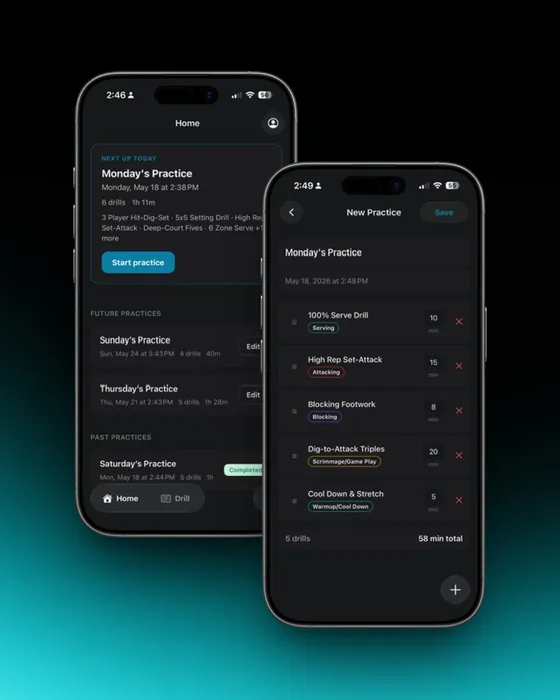
Build a timed warm-up block in SoloCoach

Drop pepper and movement drills into a plan, set an 8–12 minute timer, and move straight into your primary skill block from your phone.

Build your first practice plan, free
SoloCoach app, practice home screen and plan builder

Practice Opener Warm-Ups

High-touch ball control to open a training session. Start cooperative, then add multi-player pepper and stations.

2 Player Pepper with Sets

2+ playersBalls10 min

Two players run a continuous dig-set-attack sequence between them, incorporating a full set into the standard pepper pattern. Blends skill execution with a warm-up pace that gradually elevates intensity.

  1. Partners stand 10–12 feet apart facing each other.
  2. Player A initiates with an underhand toss. Player B digs up to themselves.
  3. Player B sets the ball above their head, then attacks down at Player A.
  4. Player A digs, sets to themselves, and attacks back at Player B.
  5. Continue the sequence: dig → set → attack → dig. Build pace gradually as the pattern stabilizes.

Coaching Cues

  • The set must go straight up and come back to you, if it drifts, your attack is compromised.
  • Control your attack: aim at your partner's platform zone, not at their face.
  • Warm-up pace means 60–70% effort on the attack, this is about touch, not power.

20-Second Pairs Pepper then Rotate

4+ playersBalls10 min

Pairs pepper for 20 seconds, then rotate to a new partner immediately. High-energy warm-up that introduces every player to every other player in a short window.

  1. All players pair up spread across the gym. Each pair starts with a ball.
  2. On "go," pairs begin pepper: dig → set → attack, controlled.
  3. After exactly 20 seconds, coach calls "rotate", all players drop their ball and move clockwise to the next partner.
  4. New pair picks up the nearest ball and resumes pepper immediately.
  5. Continue rotating every 20 seconds for 5 minutes total.

Coaching Cues

  • Get into rhythm fast, 20 seconds is short. Do not spend 10 of them getting started.
  • Match your new partner's pace immediately. Some partners are faster, some slower, adapt.
  • This warm-up builds team chemistry: intentionally communicate with every partner you rotate to.

4 Player Pepper

4+ playersBalls10 min

Four players run a continuous pepper sequence in a line or square, incorporating all four players into the pass-set-attack chain. More complexity than 2-player pepper, builds multi-player ball control.

  1. Four players form a square or line, 8–10 feet apart.
  2. Player 1 digs to Player 2. Player 2 sets to Player 3. Player 3 attacks at Player 4.
  3. Player 4 digs to Player 3. Player 3 sets to Player 2. Player 2 attacks at Player 1.
  4. Continue the sequence back and forth. All four players rotate roles continuously.
  5. Count consecutive successful sequences (dig → set → attack) without the ball dropping.

Coaching Cues

  • Each player has a defined role at any given moment, know who you're receiving from and delivering to.
  • Keep the attack controlled: your job is to give the next player a diggable ball, not win the point.
  • Communicate: call "mine" on every ball, even in a structured four-player sequence.

Pass Set Hit Shuttle Warmup

6+ playersBalls10 min

Players move through three stations in a shuttle pattern, passing, then setting, then hitting, in a continuous warm-up flow that touches all three major skills before practice begins.

  1. Set up three stations: Station 1 (passing pairs), Station 2 (setting wall or to a target), Station 3 (controlled hitting line).
  2. Players rotate through all three stations, spending 2 minutes at each.
  3. Station 1: partners pass back and forth, building rhythm.
  4. Station 2: setter delivers sets to a target, consistent form, light effort.
  5. Station 3: hitters take half-effort approach swings against a tossed ball.

Coaching Cues

  • Warm-up means gradual, start at 50% effort in Station 1 and arrive at 80% in Station 3.
  • Do not skip the mental engagement at each station. Focus on your technique, not just getting the reps done.
  • Coaches: watch for technique errors during warm-up, they are easier to correct here than mid-drill.

Game-Day Warm-Up Drills

Shorter, higher-readiness warm-ups before a match. Skip long teaching stations — movement, touch, then serve.

No Ball Movement

1+ playersNone10 min

A physical warm-up drill performed entirely without a ball, players execute volleyball movements (shuffle steps, defensive drops, jump approaches) on coach's commands. Prepares the body without the cognitive load of ball-handling.

  1. Players spread out across the court in base defensive positions.
  2. Coach calls out movements in sequence: "shuffle left," "drop right," "jump approach," "dive recovery," etc.
  3. Players execute each movement with full effort, no half-speed warm-up movement.
  4. Include: lateral shuffles, back-pedals, forward sprints, jump approaches at each position, and defensive drops.
  5. Run for 5–8 minutes, increasing the pace and complexity of commands toward the end.

Coaching Cues

  • Warm-up without a ball does not mean warm-up without intensity, move every joint through its full range.
  • Use this to mentally rehearse: picture the game situation as you execute each movement.
  • Coaches: vary commands unpredictably to keep players reactive, not just mechanically following a pattern.

Throw and Catch

2+ playersBalls10 min

Players throw and catch the ball to each other using overhand and underhand throws, warming up shoulders and hands before transitioning to volleyball contacts. A low-impact start for any practice session.

  1. Partners stand 10 feet apart facing each other.
  2. Player A throws overhand to Player B, who catches and throws back.
  3. After 10 throws each, switch to underhand throws.
  4. After 10 underhand throws, switch to behind-the-back tosses (casual, fun finish).
  5. Gradually increase distance to 20 feet across the sequence.

Coaching Cues

  • Use full arm extension on overhand throws, warm up the shoulder through its full range.
  • Catch with soft hands, the catch mechanic reinforces the "quiet hands" feel needed in setting.
  • Keep it light and social, this is the first 5 minutes of practice. Loose, not tense.

High 5 Contest

2+ playersBalls10 min

Partners face each other and compete to give the most high-fives using their platform, passing the ball back and forth at high-five height. A playful warm-up format that builds platform control and cooperative focus.

  1. Partners stand 6–8 feet apart. One partner starts with the ball.
  2. Partner A tosses the ball to partner B at shoulder height.
  3. Partner B passes the ball back to partner A's "high five zone", at partner A's raised hand level.
  4. Partner A receives and passes it back at the same height.
  5. Count consecutive exchanges at the correct height. Drop or wrong height resets the count.

Coaching Cues

  • Platform angle must point upward and toward your partner, flat platforms send the ball down.
  • The target is your partner's raised hand, not their face, not their feet. Be accurate.
  • The "contest" part matters: compete to beat your own best consecutive count every round.

Ball Control Circle

5+ playersBalls10 min

Players stand in a circle and keep a ball in the air using any legal contact, passes, sets, overhead contacts, without anyone touching it twice in a row. Cooperative warm-up that builds touch and spatial awareness.

  1. Players form a circle 8–10 feet in diameter.
  2. One player initiates by tossing the ball up into the center of the circle.
  3. Players contact the ball in any order, no player may hit it twice consecutively.
  4. The goal is to keep the ball alive as long as possible without it hitting the floor.
  5. Add a second ball once the group reaches 15 consecutive contacts with one ball.

Coaching Cues

  • Call "mine" or point at the ball before contacting, ambiguity with a group leads to everyone watching.
  • Direct your contact toward an open player, not just anywhere upward.
  • Stay engaged even when you're not the next contact, you might be two contacts away.

Youth and Beginner Warm-Ups

Low-pressure warm-ups that maximize touches without full-speed attacking. Keep effort at 50–60%.

Throw and Catch

2+ playersBalls10 min

Players throw and catch the ball to each other using overhand and underhand throws, warming up shoulders and hands before transitioning to volleyball contacts. A low-impact start for any practice session.

  1. Partners stand 10 feet apart facing each other.
  2. Player A throws overhand to Player B, who catches and throws back.
  3. After 10 throws each, switch to underhand throws.
  4. After 10 underhand throws, switch to behind-the-back tosses (casual, fun finish).
  5. Gradually increase distance to 20 feet across the sequence.

Coaching Cues

  • Use full arm extension on overhand throws, warm up the shoulder through its full range.
  • Catch with soft hands, the catch mechanic reinforces the "quiet hands" feel needed in setting.
  • Keep it light and social, this is the first 5 minutes of practice. Loose, not tense.

High 5 Contest

2+ playersBalls10 min

Partners face each other and compete to give the most high-fives using their platform, passing the ball back and forth at high-five height. A playful warm-up format that builds platform control and cooperative focus.

  1. Partners stand 6–8 feet apart. One partner starts with the ball.
  2. Partner A tosses the ball to partner B at shoulder height.
  3. Partner B passes the ball back to partner A's "high five zone", at partner A's raised hand level.
  4. Partner A receives and passes it back at the same height.
  5. Count consecutive exchanges at the correct height. Drop or wrong height resets the count.

Coaching Cues

  • Platform angle must point upward and toward your partner, flat platforms send the ball down.
  • The target is your partner's raised hand, not their face, not their feet. Be accurate.
  • The "contest" part matters: compete to beat your own best consecutive count every round.

Ball Control Circle

5+ playersBalls10 min

Players stand in a circle and keep a ball in the air using any legal contact, passes, sets, overhead contacts, without anyone touching it twice in a row. Cooperative warm-up that builds touch and spatial awareness.

  1. Players form a circle 8–10 feet in diameter.
  2. One player initiates by tossing the ball up into the center of the circle.
  3. Players contact the ball in any order, no player may hit it twice consecutively.
  4. The goal is to keep the ball alive as long as possible without it hitting the floor.
  5. Add a second ball once the group reaches 15 consecutive contacts with one ball.

Coaching Cues

  • Call "mine" or point at the ball before contacting, ambiguity with a group leads to everyone watching.
  • Direct your contact toward an open player, not just anywhere upward.
  • Stay engaged even when you're not the next contact, you might be two contacts away.

2 Player Pepper with Sets

2+ playersBalls10 min

Two players run a continuous dig-set-attack sequence between them, incorporating a full set into the standard pepper pattern. Blends skill execution with a warm-up pace that gradually elevates intensity.

  1. Partners stand 10–12 feet apart facing each other.
  2. Player A initiates with an underhand toss. Player B digs up to themselves.
  3. Player B sets the ball above their head, then attacks down at Player A.
  4. Player A digs, sets to themselves, and attacks back at Player B.
  5. Continue the sequence: dig → set → attack → dig. Build pace gradually as the pattern stabilizes.

Coaching Cues

  • The set must go straight up and come back to you, if it drifts, your attack is compromised.
  • Control your attack: aim at your partner's platform zone, not at their face.
  • Warm-up pace means 60–70% effort on the attack, this is about touch, not power.

How to Progress a Volleyball Warm-Up

  1. Step 1

    Start without cognitive load. Throw and Catch or No Ball Movement for 3–5 minutes so shoulders and hips move before platform contact.

  2. Step 2

    Add cooperative ball control. Pairs pepper, High 5 Contest, or Ball Control Circle until every player has touched the ball repeatedly.

  3. Step 3

    Raise complexity. 4 Player Pepper or Pass-Set-Hit Shuttle when the gym is warm and you want skill-specific activation.

  4. Step 4

    On game day, cut to 8–10 minutes: movement → short pepper → serve a few warm-up balls. Save teaching for practice.

Volleyball Warm-Up Drills, Frequently Asked Questions

What are volleyball warm up drills?
Volleyball warm up drills prepare movement and first contact before skill work or a match: pepper, circle keep-ups, no-ball footwork, and light station work. They raise intensity gradually so the first teachable drill is not the first ball contact of the day.
How to prepare for volleyball practice?
Arrive ready to move: 3–5 minutes of dynamic movement or throw-and-catch, then 5–10 minutes of pepper or ball-control warm-ups so every player contacts the ball before the primary skill block. Keep coaching cues short; save technique lectures for the skill block.
What are the best volleyball warm up drills before a game?
Keep it short: No Ball Movement or light shuffles, then pairs pepper or High 5 Contest, then a few match-pace serves. Skip long station warm-ups and teaching drills on game day: the goal is readiness, not reps.
What volleyball warm up drills work for beginners and youth?
Throw and Catch, High 5 Contest, Ball Control Circle, and controlled pairs pepper. Keep groups small, effort at 50–60%, and avoid full-speed attacking in the first ten minutes.
How long should a volleyball warm-up last?
Eight to fifteen minutes in practice; eight to ten before a match. If attention drops, cut stations and finish with pepper rather than extending a cold lecture.
    Volleyball Warm-Up Drills for Practice & Games | SoloCoach