What are volleyball serve receive drills? They train first contact off a live serve — platform angle, early movement, and a pass the setter can attack. Rate every ball 0–3. Error-free passing wins more sideouts than a handful of perfect 3s. Pair these with platform passing drills if the contact itself is still late.

Volleyball Serve Receive Drills

Serve receive is not the same as partner passing. The ball is faster, the toss is gone, and the passer has to start moving before the server contacts the ball. Teams that only pass tossed balls look fine in warmup and fold in the first rotation.

These volleyball drills for serve receive are from the SoloCoach library. They cover high-rep butterfly and stat tracking, then full-formation work including libero scoring games. Pair them with the passing hub for platform mechanics and the serving hub so servers and passers train in the same window.

Hold a 2.0 pass average as the floor. Below that, stay on tossed-ball platform work. At 2.0, run Butterfly and Serve and Receive Stat Drill. Add Team Receive and Libero Serve and Pass Game when the starting rotation has to sideout in a match.

From the makers of SoloStats

Build a serve-receive block in SoloCoach

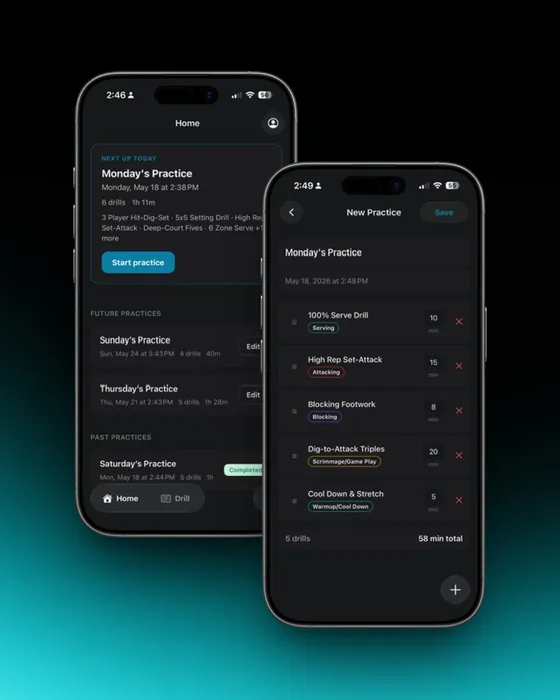
Filter passing drills, set a 15-minute serve-receive block, and run it with a countdown so the next server is always ready.

Build your first practice plan — free
SoloCoach app — practice home screen and plan builder

High-Rep Serve Receive Drills

Track pass quality on a 0–3 scale. These drills isolate first contact without a full offensive system.

Butterfly Serve and Receive

8+ playersBalls15 min

A continuous movement drill where servers, passers, and shagging players rotate through stations in a butterfly pattern. Builds serve-receive repetitions at high volume with built-in movement.

  1. Set up two serving lines at opposite baselines and two passing zones on each side of the net.
  2. Server serves, then follows the ball by running around the net to the opposite passing zone.
  3. Passer receives the serve, passes to a target, then follows their pass to the back of the serving line.
  4. Keep the flow continuous — as soon as a pass is made, the next server goes.
  5. Coach monitors pass quality; call out the score (1–3) for each pass as play flows.

Coaching Cues

  • Passers: get to your spot before the serve crosses the net — late movement kills your platform angle.
  • Keep the butterfly moving — a slow rotation breaks rhythm and reduces reps.
  • Servers: vary serve type and location; do not just lob the same ball every time.

Serve and Receive Stat Drill

4+ playersBalls15 min

Structured serve-receive reps with real-time tracking of pass quality ratings. Gives teams measurable data on serve-receive efficiency over time.

  1. Set two or three passers in their serve-receive formation.
  2. Coach or designated server delivers 20 balls, mixing float and topspin serves.
  3. After each pass, rate it on a 0–3 scale and record it on a clipboard or whiteboard.
  4. After 20 balls, calculate pass average (total points / 20).
  5. Rotate passers and repeat — compare averages across rotations.

Coaching Cues

  • Target pass average is 2.0 or above — below that, technique needs work before competition.
  • Track error rate separately: any pass rated 0 or 1 is a breakdown point in a real match.
  • Use the stats to have a coaching conversation — "your average dropped when she served cross-court, why?"

Perfect Pass Competition

4+ playersBalls10 min

Players compete to achieve the highest score of perfect passes (rated 3) out of a defined set of serve-receive reps. Adds accountability and measurement to serve receive.

  1. Set up a standard serve-receive formation with 2–3 passers.
  2. Server delivers 10 balls, mixing float, topspin, and varied locations.
  3. Coach rates each pass: 3 (perfect — on setter target), 2 (playable), 1 (off target or error).
  4. Total the score after 10 balls. Rotate passers and repeat.
  5. Track scores across rounds; teams or individuals compete for the best total.

Coaching Cues

  • A "3" means it lands exactly where the setter can attack without adjusting — hold that standard.
  • Passers: talk after each serve — what did you see? What would you change?
  • A 20/30 is the target score for two passers; push to hit it consistently before moving on.

Catch Serves Competition

4+ playersBalls10 min

Receivers compete to "catch" (perfectly platform-pass) the most serves in a row. Gamifies serve receive with a clear performance metric and competitive pressure.

  1. Two receivers set up in a standard 2-person serve-receive formation.
  2. One server serves a set of 10 balls — mixing float and topspin, varying location.
  3. A "catch" = a pass that lands within a defined target zone (hula hoop or floor marking).
  4. Count total catches out of 10. Receivers rotate after each set of 10.
  5. Play two rounds each and compare scores — team with most catches wins.

Coaching Cues

  • Read the server's toss early — the toss tells you float vs. topspin before contact.
  • Call the ball loudly and move first; a "catch" requires footwork, not just arms.
  • After each serve, reset your stance immediately in case of a quick second ball.

Serve Receive Error % Drill

4+ playersBalls10 min

Tracks the error rate in serve receive over a high volume of reps. Focused specifically on eliminating passing errors rather than optimizing perfect passes.

  1. Set your standard serve-receive formation with 2–3 passers.
  2. Server delivers 20 serves — competitive pace, varying location and type.
  3. Only track errors: passes that hit the floor, go into the net, or land out of play.
  4. Calculate error rate: errors / 20 serves.
  5. Benchmark: under 10% error rate (2 or fewer errors per 20) is match-ready.

Coaching Cues

  • Eliminating errors is more valuable than maximizing perfect passes — errors give the opponent free points.
  • When in doubt, shanked balls should go up, not into the net.
  • Passers: your job first is to keep the ball in play — perfection is second.

Ace the Receiver or Perfect Pass

4+ playersBalls10 min

Servers compete to ace receivers while receivers compete to pass perfectly. A competitive 1v1 format that makes serving and passing sharper under pressure.

  1. Pair up players: one server at the baseline, one receiver in the back court.
  2. Server scores a point for an ace or a pass rated below 2. Receiver scores for a perfect pass (rated 3).
  3. Play to 7 points, then switch roles.
  4. Servers should vary location — corners, seams, and short zones.
  5. Coach rates each pass aloud so both players get immediate feedback.

Coaching Cues

  • Receivers: stay in an athletic ready stance between serves — flat feet get aced.
  • Servers: aim for the seam between two receivers or the deep corners, not the middle of the court.
  • Pressure is the point — treat every serve as match-point.

Team Serve Receive Drills

Formation, communication, and libero work. Use these once players can pass a tossed ball on target.

Team Receive Drill

6+ playersBalls15 min

Full team runs their serve-receive formation against a live server. Emphasizes system execution, communication, and consistent pass quality across the full rotation.

  1. Set the full team in their serve-receive formation for a specified rotation.
  2. Server serves from the baseline, varying serve type and location.
  3. Passers call balls early and pass to the setter target.
  4. Setter catches or sets the second ball — focus is on the pass quality to zone 2.
  5. After 10 serves, rotate one position and repeat.

Coaching Cues

  • The first call (mine / yours) must happen before the ball crosses the net — not after.
  • Non-passers: stay in position and ready to help on seam balls — no standing and watching.
  • Setter: give verbal feedback on pass quality immediately — "good pass" or "I had to move" keeps standards high.

4 Team Serve and Receive Deep Court

8+ playersBalls15 min

Four teams rotate through serving and receiving on a deep court setup, emphasizing passing from the baseline and handling deep, heavy serves.

  1. Divide players into 4 teams of 2–3. Two teams serve from one baseline, two receive on the other side.
  2. Servers target the deep third of the court — baseline and deep corners only.
  3. Receivers pass every ball to a designated setter target at position 2.
  4. Track pass quality: 3 = on target, 2 = playable, 1 = off target.
  5. After each rally, rotate: receiving team becomes servers, servers move to end of the line.

Coaching Cues

  • Start your footwork before the server contacts the ball — never wait for it to cross the net.
  • Deep serves require you to move back first, then forward into the ball — not the other way around.
  • Platform angle is your aim — point it at the setter target before you swing your arms.

Triples Serve-Receive Competition

6+ playersBalls15 min

Two teams of three compete in serve-receive, with the passing team earning points for quality passes and the serving team earning points for aces or errors. High-stakes format for rapid improvement.

  1. Teams of 3: one team serves, one team receives in a 3-player formation.
  2. Server scores 2 for an ace, 1 for a pass rated 1 or below.
  3. Receiving team scores 2 for a perfect pass (3 rating), 1 for a playable pass (2 rating).
  4. Play to 15, then switch roles.
  5. Track cumulative scores across multiple rounds to determine overall winner.

Coaching Cues

  • Receiving team: designate your seam coverage before the server tosses — not after.
  • Serving team: serve with intention. Pick a target on every ball — no lazy serves.
  • Use the score to motivate, not excuse: a bad round means adjust your approach, not your effort.

Libero Serve and Pass Game

6+ playersBalls15 min

The libero competes directly against a server — the server scores for aces or poor passes, the libero scores for perfect passes. Isolates and pressures the most important serve-receive role on the team.

  1. Libero sets up in the back row; server stands at the baseline on the opposite side.
  2. One or two additional passers fill out the formation — libero calls the seams.
  3. Server serves aggressively — targeting libero's zone with float and topspin.
  4. Libero scores 2 points for a perfect pass, 1 point for a playable pass. Server scores 2 for an ace.
  5. Play to 15 points, then rotate a new server in.

Coaching Cues

  • Libero: you own the back court — be loud, be early, claim every ball in your zone.
  • Shuffle to the ball, don't cross your feet; crossing slows your platform setup.
  • Read the server's hips and toss to anticipate direction before contact.

How to Progress Serve Receive Training

  1. Step 1

    Start with Butterfly Serve and Receive or Catch Serves Competition so every player gets a high volume of first contacts. Call the 0–3 rating out loud.

  2. Step 2

    Add measurement. Serve and Receive Stat Drill and Serve Receive Error % Drill tell you whether the problem is errors or a lack of 3s. Fix errors first.

  3. Step 3

    Move to formation. Team Receive Drill and 4 Team Serve and Receive Deep Court add seam calls and rotation. Triples Serve-Receive Competition adds scoring pressure.

  4. Step 4

    Finish with the libero. Libero Serve and Pass Game isolates the player who should take the most serves. Link back to passing drills if the platform itself is the problem, not the formation.

Volleyball Serve Receive Drills — Frequently Asked Questions

What are the best volleyball drills for serve receive?
Butterfly Serve and Receive for volume, Serve and Receive Stat Drill for measurement, and Team Receive Drill for formation. Rate every pass 0–3 so the gym has a standard.
How do you score serve receive in practice?
Use a 0–3 scale: 3 is on the setter target, 2 is playable, 1 is off target, 0 is an error. A 2.0 average is match-ready. Track error rate separately — errors give away free points.
How much serve receive should be in a volleyball practice?
About 15–25 minutes, and more if sideout is the match problem. Blend serving and passing in the same block so servers face a real passer.
When should you use a three-person serve receive?
After two passers can hold a 2.0 average. Team Receive Drill and Triples Serve-Receive Competition are the right next step. Do not jump to a full rotation if the platform is still late.
How is serve receive different from passing drills?
Passing drills build platform shape off a toss. Serve receive drills start with a live serve, early movement, and a target at position 2. Use both — mechanics on the passing page, first contact here.
    Volleyball Serve Receive Drills — Pass Ratings | SoloCoach